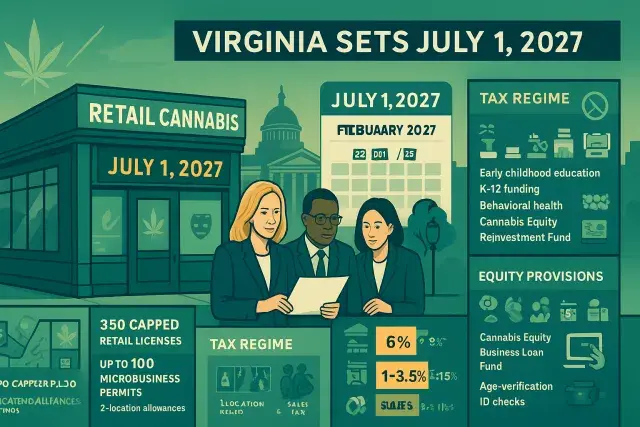
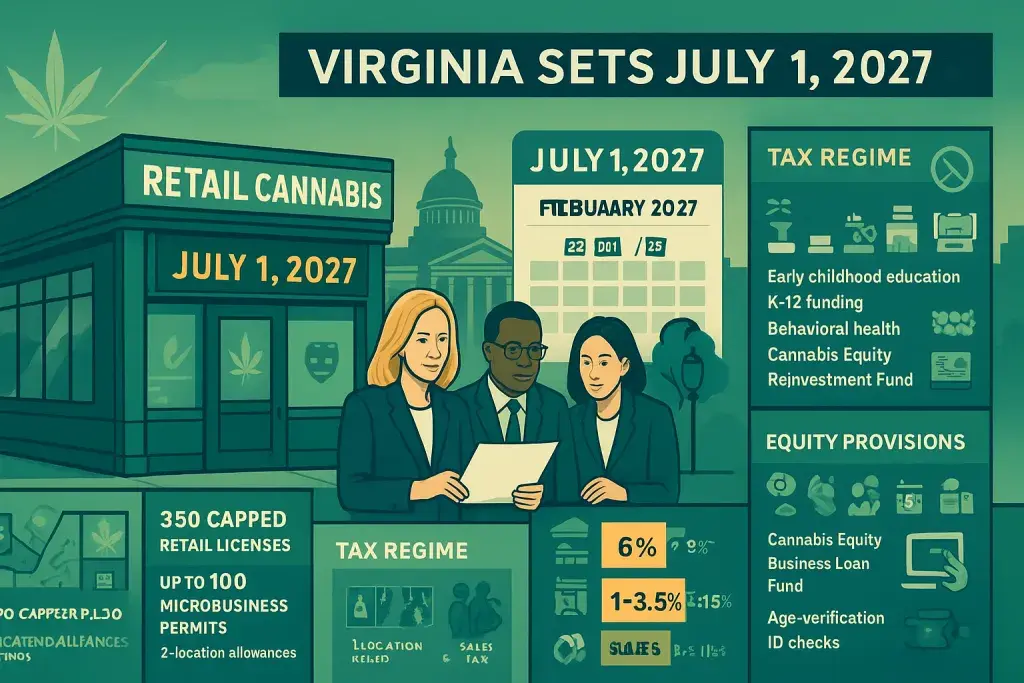
Virginia has a launch date. State lawmakers and Gov. Abigail Spanberger announced Tuesday that legal recreational cannabis sales will begin July 1, 2027, under a compromise framework built into the state budget - ending years of regulatory limbo that followed Virginia's 2021 adult-use possession law. The agreement establishes a licensing structure, tax regime, consumer safety requirements, and equity provisions, giving the Virginia Cannabis Control Authority roughly 18 months to stand up a fully operational regulatory program before the first legal sale rings through a point-of-sale terminal.
The gap between legalization and a functioning retail market is familiar territory for states that moved faster on possession than on regulation. That lag creates real commercial consequences: without licensed retail, tested products, and compliant supply chains, consumers default to unregulated sources, illicit operators hold market share, and the groundwork for a legitimate industry stalls. Other states that built retail frameworks from scratch - including Maine, where operators eventually required purpose-built marijuana pos software maine to manage seed-to-sale compliance, inventory tracking, and age verification at the dispensary level - found that standing up the technology and compliance infrastructure takes longer than legislators often anticipate. Virginia now has a fixed timeline, which is both a commitment and a pressure test for the CCA.
The framework caps retail cannabis establishment licenses at 350 and allows the CCA to begin accepting applications February 1, 2027 - five months before sales open. That sequencing matters. Operators will need to move quickly on real estate, capital formation, staffing, and vendor relationships the moment licensing opens. Retail stores must be sited at least 1,000 feet from schools, hospitals, playgrounds, and drug treatment facilities, a zoning constraint that will meaningfully compress the available footprint in dense localities and drive competition for compliant locations. Landlords in urban corridors should expect elevated interest from applicants working within that buffer math.
Tax Structure and What It Means for Dispensary Economics
The deal sets an initial 6 percent state excise tax on cannabis products, rising to 8 percent after July 1, 2029. On top of that, localities can layer in a 1 percent to 3.5 percent local tax, and existing retail sales and use taxes apply as well. That stacking effect is standard in regulated cannabis markets - but operators need to model it carefully from the start. A combined tax burden in the upper range could approach 12 percent or more in certain jurisdictions before standard sales tax is added, which compresses margin and raises the price point consumers see at the counter.
Here's the catch operators in other states know well: if the legal market is priced too far above the illicit market, the gray market doesn't shrink - it grows. Sen. Lashrecse Aird put it plainly: Virginia's current system has left illicit sellers to fill the gap. The compromise's stated goal of making licensed retail "affordable and accessible enough to actually compete" is the right instinct. Whether that holds depends on how localities apply the discretionary local tax and how aggressively the CCA enforces against unlicensed activity. Revenue from cannabis sales is directed toward early childhood care and education, K-12 education, behavioral health, and the Cannabis Equity Reinvestment Fund - a distribution structure that gives legislators a political reason to want the legal market to generate volume.
Equity Provisions and Access to Capital
The framework includes provisions designed to give smaller operators a real entry point, not just a nominal one. Seventy-five percent of first-year license fee deposits flow into the Cannabis Equity Business Loan Fund. The CCA can issue up to 100 microbusiness licenses by May 1, 2027 - ahead of the general retail launch - with those licensees permitted to operate up to two locations. Impact licensees get a five-year holding period with limits on ownership transfers, and the framework includes revocation tools for prohibited license changes. That last piece addresses a recurring problem in other states: equity licenses that change hands through informal arrangements, effectively transferring the economic benefit away from the intended recipient.
Access to capital remains the most persistent structural barrier for small cannabis operators. A license without working capital to build out a retail space, hire staff, stock inventory, and carry 90 to 120 days of operating expenses is a license that sits unused - or gets sold. Directing fee revenue into a dedicated loan fund is a mechanism other states have tried with mixed results; execution depends entirely on how the fund is administered, what the loan terms look like, and whether the application process is accessible to applicants without existing financial infrastructure.
Consumer Safety, Compliance Standards, and Hemp Regulation
The agreement imposes a concrete set of consumer protection requirements that will define operational compliance for every licensed retailer in the state. The framework bans cartoon advertisements, mandates child-resistant packaging, and prohibits products shaped like animals, fruits, vehicles, or humans - a direct response to the confectionery-style products that have drawn federal and state scrutiny across regulated markets. Retailers that fail to verify age face escalating penalties up to license revocation. Those are not symbolic provisions; they translate directly into staff training protocols, ID-check logs, product procurement decisions, and POS system configuration.
The agreement also shifts oversight of industrial intoxicating hemp from the Virginia Department of Agriculture and Consumer Services to the CCA and closes what Spanberger's office called the "25:1 hemp loophole" - a regulatory gap that allowed high-THC hemp-derived products to circulate with minimal oversight. That consolidation puts hemp-derived intoxicating products under the same regulatory authority as licensed cannabis retail, which should reduce the arbitrage that has allowed unregulated high-potency products to undercut licensed dispensaries on price and availability. The CCA gains authority over a public licensee registry, an anonymous tip line for illicit activity, ownership investigation tools, and audit authority over financial relationships - the infrastructure of a functioning enforcement program, not just a licensing office.
The framework also includes seed-to-sale tracking, product testing requirements, licensing administration, and disciplinary tools. None of that is novel - it mirrors what mature regulated markets have built over years. What's striking here is that Virginia is trying to compress the build phase into roughly 18 months while also standing up an equity lending program, processing up to 350 retail applications, issuing 100 microbusiness licenses, and transferring regulatory authority over the hemp market. That is a substantial operational lift for a regulatory body working on a legislative clock. Whether the CCA has the staffing and systems to execute it cleanly will determine whether July 1, 2027 is a real opening date or an aspirational one.