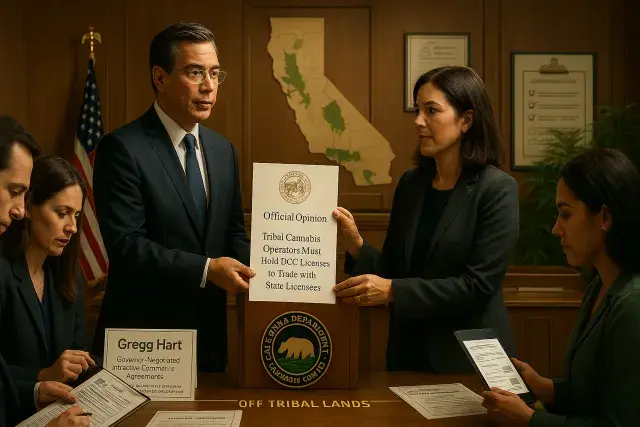
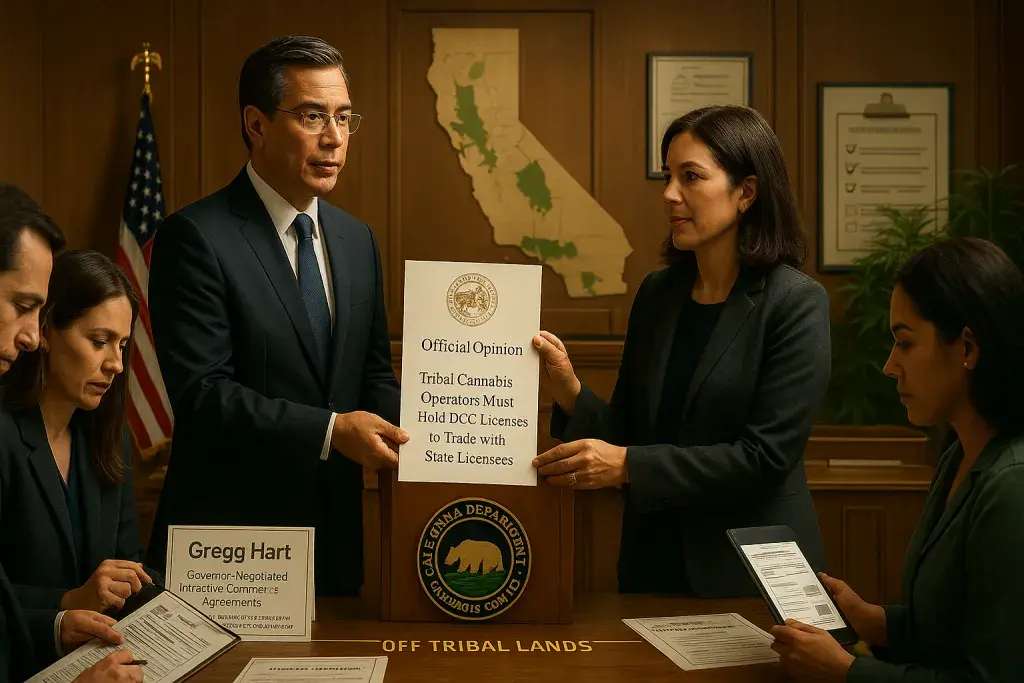
California Attorney General Rob Bonta's office has delivered a clear answer to a question that licensed cannabis businesses and tribal operators have been circling for some time: federally recognized Indian tribes cannot engage in commercial cannabis activity with state-licensed businesses off tribal lands unless they first obtain a license from the California Department of Cannabis Control. The formal opinion, issued in response to a request from Assemblymember Anamarie Avila Farias, draws a hard boundary around the existing regulatory framework - one that has direct operational consequences for any wholesaler, retailer, or distributor that might have been weighing a commercial relationship with tribally licensed cannabis operations.
What the Opinion Actually Says - and Why Operators Should Read It Carefully
The question Avila Farias posed was specific: could a tribe with its own cannabis regulatory framework - one substantially comparable to California's - transact with state licensees off tribal lands without a DCC-issued commercial license? Bonta's office said no, without much ambiguity.
"State law does not allow a California cannabis licensee to lawfully conduct commercial cannabis activity with an entity who holds a commercial cannabis license issued by a tribal authority instead of the state," the opinion reads. That's not a soft caution. That's a compliance line.
For dispensary operators, this matters at the inventory and procurement level. If a licensed retailer were sourcing product from a tribally licensed cultivator or manufacturer that did not also hold a DCC license, that transaction would sit outside the lawful framework - exposing the state licensee to civil or criminal penalties. The DCC tracks commercial cannabis activity through its seed-to-sale oversight requirements, and any product moving through a licensed retailer's point-of-sale system without a compliant upstream chain of custody is a compliance liability, full stop.
The opinion also reinforces existing law more than it creates new restrictions. Current California statute already allows tribes to participate in the commercial cannabis market - as California licensees. The pathway exists. What doesn't exist is a parallel pathway that bypasses the DCC licensing process entirely, regardless of how rigorous a tribe's own regulatory framework might be.
The Legislative Context Running Alongside This Opinion
The timing here is not coincidental. Assemblymember Gregg Hart has been moving a bill through the legislature that would authorize the governor to enter into agreements with federally recognized tribes for intrastate cannabis commerce with state licensees - building on an existing statute that similarly empowers the governor to broker interstate commerce agreements with other states. That bill passed the Assembly 77-0 and is now before the Senate.
What the Hart bill envisions, essentially, is a structured pathway - governor-negotiated, agreement-based - for tribal cannabis operators to transact with state licensees. The attorney general's opinion doesn't kill that bill. What it does is confirm that, absent such a formalized agreement and absent a DCC license, no such commerce is currently permissible. The bill's passage, if it becomes law, would create an authorization mechanism, not an automatic green light.
There's a federal wrinkle here, too. The Hart bill includes language conditioning tribal commerce agreements on "federal approval or toleration" - the same standard embedded in California's existing interstate commerce law. That language didn't land by accident. Bonta's office previously concluded, in a 2023 opinion requested by DCC itself, that authorizing interstate cannabis commerce could expose the state to significant federal enforcement risk under the Controlled Substances Act. DCC is currently awaiting definitive federal guidance before moving on interstate agreements. The same logic applies to the tribal framework - a point the legislative architecture of the Hart bill appears to acknowledge.
The Rescheduling Question Hanging Over All of This
Cannabis advocates have been pressing the question of whether federal rescheduling changes the calculus on state-level commerce agreements. The Trump administration's Justice Department has moved forward with rescheduling medical marijuana, and some observers have argued that this development could reduce the federal enforcement risk that Bonta's office flagged in 2023. The answer, so far, is: not yet definitively enough for California to act.
DCC has not requested a follow-up opinion from the attorney general's office on the interstate question in light of rescheduling. A department spokesperson confirmed the agency is waiting for clearer federal guidance before moving. That's a reasonable posture given the legal exposure the 2023 opinion identified - but it also means licensed operators in California are still operating in a holding pattern on cross-border and, now explicitly, cross-sovereign commercial relationships.
What DCC has moved on is the more immediate business implication of rescheduling: proposing emergency regulations to allow businesses holding both adult-use and medical-use licenses to separate those operations through a streamlined secondary licensing process. This matters because rescheduling currently applies only to medical cannabis - which means tax treatment, including potential relief from the 280E provisions that have long restricted cannabis businesses from deducting standard business expenses, may differ depending on how a licensee's operations are structured. Getting that license segmentation right is, at this point, an active compliance task for any multi-designation operator in the state.
What Licensed Operators Should Take Away
The attorney general's opinion doesn't close a door that was previously open. It clarifies a boundary that the existing licensing framework had already implied. But clarity matters in a compliance environment where ambiguity can be interpreted - sometimes optimistically, sometimes recklessly - as operational flexibility.
For dispensary operators and wholesale buyers, the practical guidance here is straightforward: any commercial cannabis partner, including tribally affiliated operations, must hold a DCC-issued license for transactions occurring off tribal lands to be lawful under California law. Reviewing supplier and vendor licensing status isn't a formality - it's part of the compliance chain that protects a retailer's own license standing. A certificate of analysis covers product safety; a valid DCC license covers the transaction itself.
The broader tension - between tribal sovereignty, state regulatory authority, and federal preemption - isn't resolved by this opinion. It's delineated. The Hart bill, if enacted, would create new mechanisms for resolution. Until then, state licensees operating in California need to treat the DCC framework as the single authoritative licensing standard for any commercial activity beyond tribal land boundaries. There's no workaround that doesn't carry legal risk.