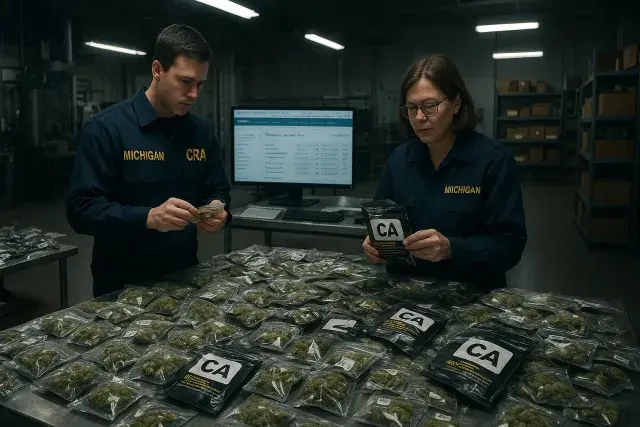
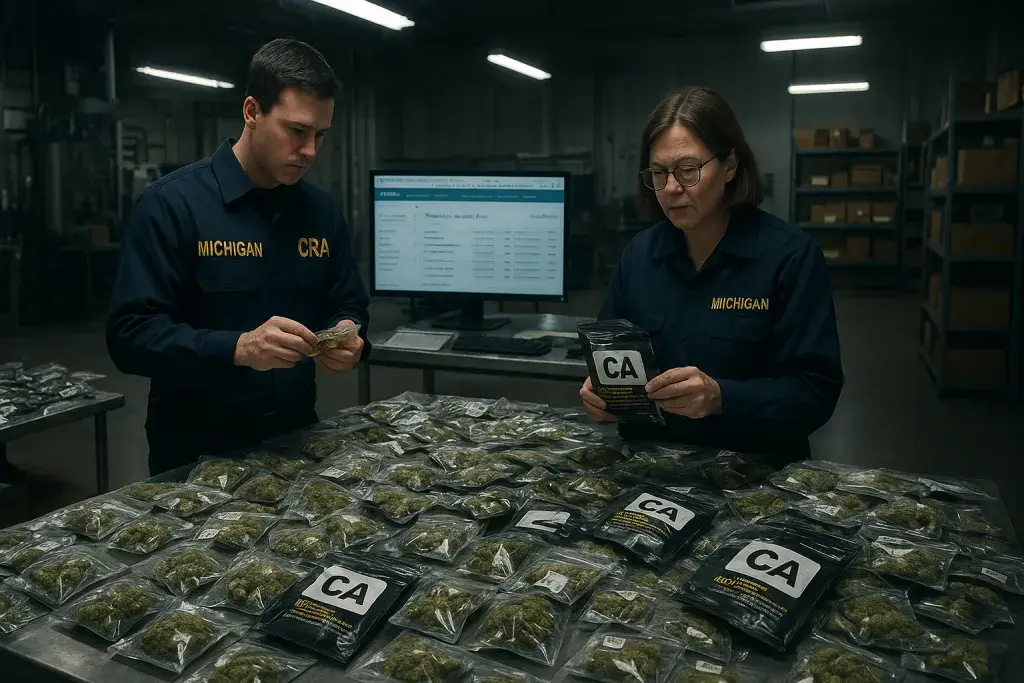
Michigan's Cannabis Regulatory Agency has filed a formal complaint against VJAS 1, a licensed cannabis processor operating out of Harrison Township, after inspectors discovered more than 12,000 individual cannabis products on-site with no Metrc tags or other identifying information. Among those untagged products were items in California-specific packaging - bearing the letters "CA" and California-mandated warning language - raising the possibility that untracked, out-of-state product had entered a licensed Michigan facility. The processor now faces fines and the potential suspension, revocation, restriction, or outright non-renewal of its license.
The case is a sharp reminder of how seed-to-sale tracking systems are supposed to catch exactly this kind of discrepancy - and what happens when they don't. Metrc, the tracking platform used in Michigan and most other regulated cannabis states, assigns a unique RFID tag to every cannabis plant and product batch moving through the supply chain. Every transfer, sale, and inventory adjustment is supposed to be logged in real time. The system isn't foolproof, but it does create a compliance paper trail that regulators can audit against physical inventory during an inspection. Operators running multi-location businesses or managing high SKU counts sometimes cite inventory management complexity as a pressure point - a challenge that purpose-built cannabis pos systems maryland and similar state-specific retail technology tools are designed to help address by integrating directly with state tracking platforms. The question VJAS 1 cannot easily answer: how do you end up with 12,000 untagged units and no explanation?
What makes this case more serious than a routine inventory discrepancy is the California packaging. Compliant packaging in regulated cannabis markets is jurisdiction-specific - warning text, required icons, and label language differ by state, and California's requirements are distinct enough that product in CA-compliant packaging is effectively identifiable as California-market product. If material produced or distributed for the California market appeared in a Michigan licensed facility without Metrc tags, the logical inference is that product moved outside of licensed, tracked channels. That's not a paperwork gap. It's a supply chain integrity problem, and regulators treat it accordingly.
What Investigators Found - and What the Facility Couldn't Explain
The CRA inspection turned up a secondary problem alongside the untagged inventory. Some products at the VJAS 1 facility did carry valid Metrc tags - but when investigators cross-referenced those tags against the state system, the products were recorded as being located at other licensed cannabis businesses. That's a red flag on two levels. First, it suggests that tagged product may have been physically moved without the corresponding Metrc transfer being recorded, which breaks the chain of custody the tracking system is built to maintain. Second, it means those other licensees may have inventory records showing compliant stock that isn't actually in their possession.
Employees on-site during the inspection were reportedly unable to explain the volume of untagged product or how it came to be in the facility. In a licensed cannabis operation, that's a significant institutional failure. Metrc compliance isn't incidental to cannabis processing - it's foundational. Every product batch entering or leaving a licensed facility is required to be tagged and logged. The inability to account for thousands of units isn't a minor clerical lapse; it suggests either a systemic breakdown in internal compliance protocols or something more deliberate.
The Regulatory and Business Stakes for Licensed Operators
Michigan's CRA has broad enforcement authority, and the range of consequences VJAS 1 faces reflects that. Fines, license suspension, restriction, revocation, or refusal to renew - any one of those outcomes would significantly disrupt operations. A license revocation, in particular, eliminates the business entirely in the regulated market. For a cannabis processor, which typically supplies product to multiple dispensaries and retail partners, a license suspension also creates downstream disruption for those business relationships.
The broader implication for other licensed operators is worth sitting with. Metrc audits during inspections are not unusual, and regulators in Michigan and other states regularly cross-reference physical inventory against state tracking data. Operators with sloppy tag management, delayed transfer entries, or uncorrected batch discrepancies are exposed to exactly this kind of enforcement action - even if the underlying cause is operational carelessness rather than intentional misconduct. The distinction may matter in a legal proceeding, but it doesn't make the inventory numbers compliant.
Out-of-State Product in a Licensed Facility: A Hard Line in Regulated Markets
No licensed cannabis state permits the import of cannabis product from another state. Federal law prohibits interstate cannabis commerce entirely, and state licensing frameworks are built around closed, in-state supply chains. That means product packaged for California's adult-use market has no legal pathway into a Michigan cannabis processor's inventory. If California-packaged product appeared in that facility, it either crossed state lines outside of any licensed channel, or - less likely but not impossible - it was produced domestically and mislabeled with California packaging for reasons that would need to be explained.
Either scenario creates serious compliance exposure. Consumer safety is part of the equation here too: products that haven't moved through Michigan's licensed supply chain haven't been subject to Michigan's required lab testing protocols. State-licensed markets require lab testing and certificates of analysis before cannabis products reach retail shelves - an untracked product bypasses that verification entirely, which is precisely the kind of gap regulators design enforcement actions to deter.
VJAS 1's case is still in the complaint stage. The formal process allows the licensee to respond before final enforcement action is taken. But the factual picture the CRA has laid out - 12,000-plus untagged units, California packaging, and Metrc tags that don't match the facility's physical location - is a difficult set of facts to walk back.