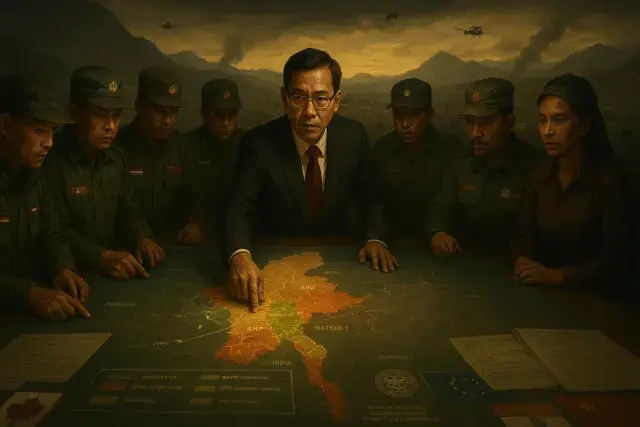
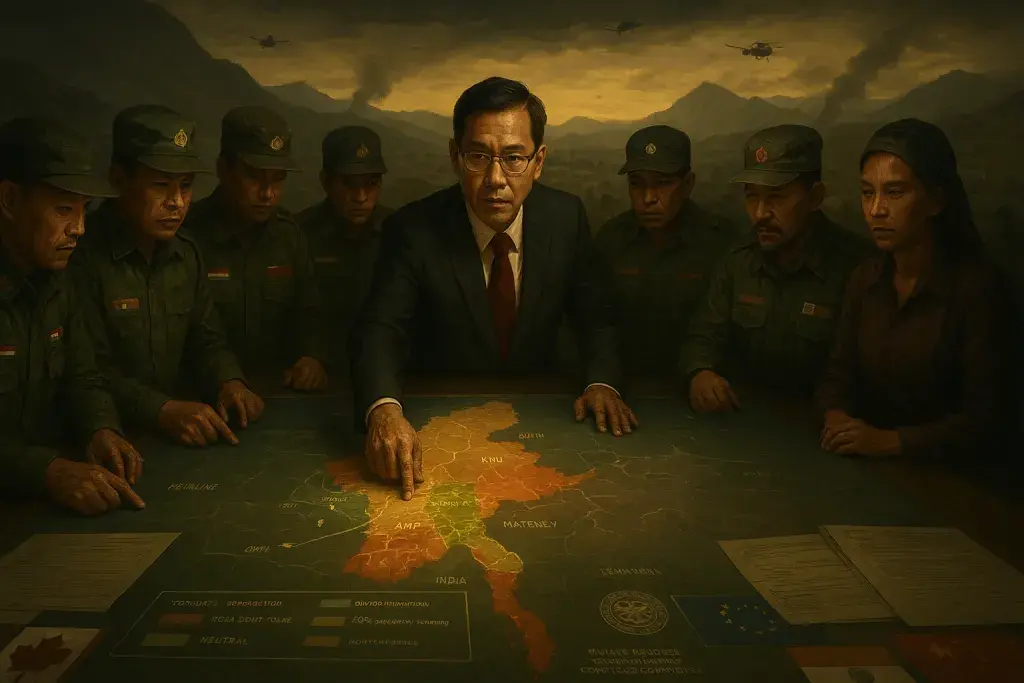
The Steering Council for the Emergence of a Federal Democratic Union-SCEF-formally established on March 30, 2026, represents the most structurally significant attempt yet to consolidate Myanmar's fragmented resistance movement into a single operational and diplomatic bloc. In a recent interview with Khit Thit Media's "People to People" program, Dr. Zaw Wai Soe, SCEF Secretariat Coordinator and federal minister in the National Unity Government (NUG), described a newly formed Military Strategic Cooperation and Command Committee led by ten military commanders drawn from member organizations. The message was deliberate: where the resistance once spoke in "two or three voices," it now aims to speak as one.
A Unified Command-What That Actually Means in Practice
The gap between a coalition announcement and genuine operational unity is, historically, enormous. Myanmar's resistance has been defined for decades by exactly the kind of fragmentation SCEF is now trying to resolve-ethnic armed organizations (EAOs) pursuing distinct territorial and political goals, issuing contradictory public statements, and maintaining separate command structures that rarely coordinated on strategy. Dr. Zaw Wai Soe acknowledged this directly: "In the past we could only declare a common understanding. Now we are working together."
SCEF's founding members-the Kachin Independence Organization (KIO), Karen National Union (KNU), Chin National Front (CNF), Karenni National Progressive Party (KNPP), and the NUG-each brings its own military force, territorial base, and political constituency. Binding them under a shared Military Strategic Cooperation and Command Committee does not erase those differences. What it does, if it holds, is create an architecture for synchronized operations and a single authoritative channel for international engagement. That second function may matter as much as the first.
The diplomatic consolidation is already producing measurable outputs. SCEF has submitted coordinated inputs to ASEAN-a development Dr. Zaw Wai Soe cited as helping sustain the bloc's critical stance toward the military junta. Previously, divergent messaging from individual EAOs and the NUG allowed the regime and its backers to characterize the opposition as internally incoherent. A unified position is harder to dismiss.
Diplomatic Priorities and the Logic Behind Them
SCEF's announced diplomatic agenda is broad but not arbitrary. Dr. Zaw Wai Soe outlined plans for an advocacy campaign in Canada, deeper EU engagement, and direct outreach to China and India-the last two being countries whose current posture most directly shapes conditions on the ground.
China's position is the most consequential variable. Beijing has provided political cover to the junta at the UN and has-selectively-pressured certain armed groups to stand down. Its perception of SCEF and the NUG as broadly pro-Western complicates any direct engagement. India's calculus is different: border security, trade continuity, and concern about Chinese influence in Myanmar's east all factor into New Delhi's transactional approach. The logic of engaging both capitals directly is sound. Whether SCEF can move either from a position of managed neutrality toward something more actively supportive of the resistance depends less on diplomatic skill than on battlefield conditions and economic leverage the coalition does not yet fully hold.
The EU outreach is more straightforward. Western democracies have already provided political and moral backing to the NUG, but SCEF's unified structure gives those governments a more credible interlocutor-one that represents not just a government-in-exile but a coalition controlling significant territory. That matters for the practical question of whether support remains rhetorical or begins to translate into more substantive assistance.
The AA Question-The Alliance Gap SCEF Cannot Afford to Leave Open
Here's the structural problem SCEF's leadership has not yet publicly resolved: the Arakan Army (AA), operating under the United League of Arakan (ULA/AA), is not a SCEF member. Neither is the Spring Revolutionary Alliance (SRA), a newly formed umbrella of roughly nineteen smaller armed groups and several larger ones.
The AA's absence matters more than any other single factor in assessing whether SCEF can deliver on its military ambitions. The AA controls significant territory in Rakhine State-including, critically, the Bangladesh border-and has demonstrated battlefield effectiveness that few other organizations in the resistance can match. De facto coordination between the AA and SCEF-aligned forces exists. But situational cooperation is not the same as strategic integration, and the distinction has real operational consequences.
The sticking points are not ideological in any simple sense. The AA insists on autonomous command and focuses primarily on Rakhine liberation rather than a unified national revolution. Its relationship with China is more nuanced than that of other EAOs-Beijing has pressured some groups to stand down while the AA has preserved independence, likely because of its strategic positioning and border control. If China perceives full AA integration into SCEF as consolidating a pro-Western bloc, it has both the incentive and the means to pressure the AA against that step.
A "SCEF + AA" model-coordination on military operations, logistics, and diplomacy without demanding full political integration-may be more achievable than formal membership and more valuable than the current informal arrangement. The same logic applies to the SRA. A flexible alliance operating under a principle of shared objectives with preserved autonomy for member organizations is less elegant on paper than a unified command. In practice, though, it may generate more actual momentum than a tighter structure that the AA will not enter.
Battlefield Realities and the Limits of Optimism
The formation of SCEF coincides with a genuinely contested military situation. Open-source territorial estimates as of May 2026 suggest opposition-aligned forces control roughly 40% of Myanmar's territory, against approximately 35% held by the junta-with the remainder divided among the United Wa State Army (UWSA), the Restoration Council of Shan State (RCSS), and other neutral or ceasefire-signatory EAOs. Anti-military forces continue to hold more than 80 towns.
That said, the picture is uneven by region. Richard Horsey of the International Crisis Group noted in a BBC Burmese Service interview on May 16, 2026, that battlefield conditions vary sharply: anti-junta forces are performing well in areas including Rakhine, while the military holds advantages in parts of the central region-Magway, Mandalay, Sagaing-and has reclaimed some territory lost during Operation 1027 in 2024-25, in some cases with Chinese support. "One cannot make a single characterization of the ongoing battlefield situation," Horsey said. That assessment is a useful corrective to both junta triumphalism and resistance optimism.
The junta has addressed some of its weaknesses-conscription enforcement has expanded manpower, and improvements in drone use and logistics are documented-without coming close to reasserting full control. Severe economic hardship inside Myanmar has created pressure on the resistance from a different direction: populations enduring prolonged conflict need evidence that the opposition can deliver governance and stability, not just territorial control. That is a political challenge SCEF's unified structure is better positioned to address than the fragmented arrangement that preceded it, but only if the coalition can sustain cohesion under sustained pressure.
What SCEF has built in four months is a framework. Whether the framework holds-and whether it can expand to incorporate the AA and SRA before battlefield dynamics shift-will determine whether this moment represents a genuine inflection point or another chapter in the resistance's long history of promising more unity than it could deliver.