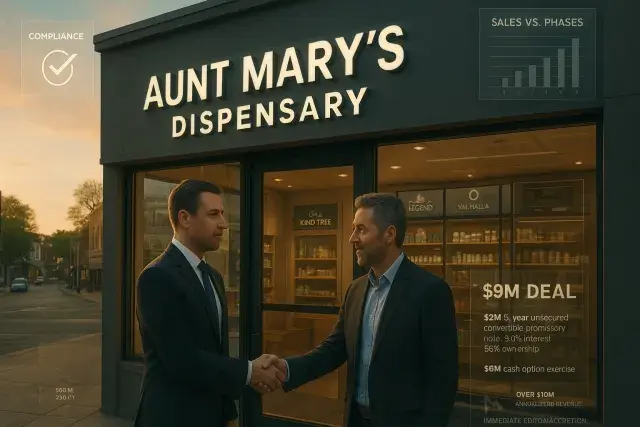
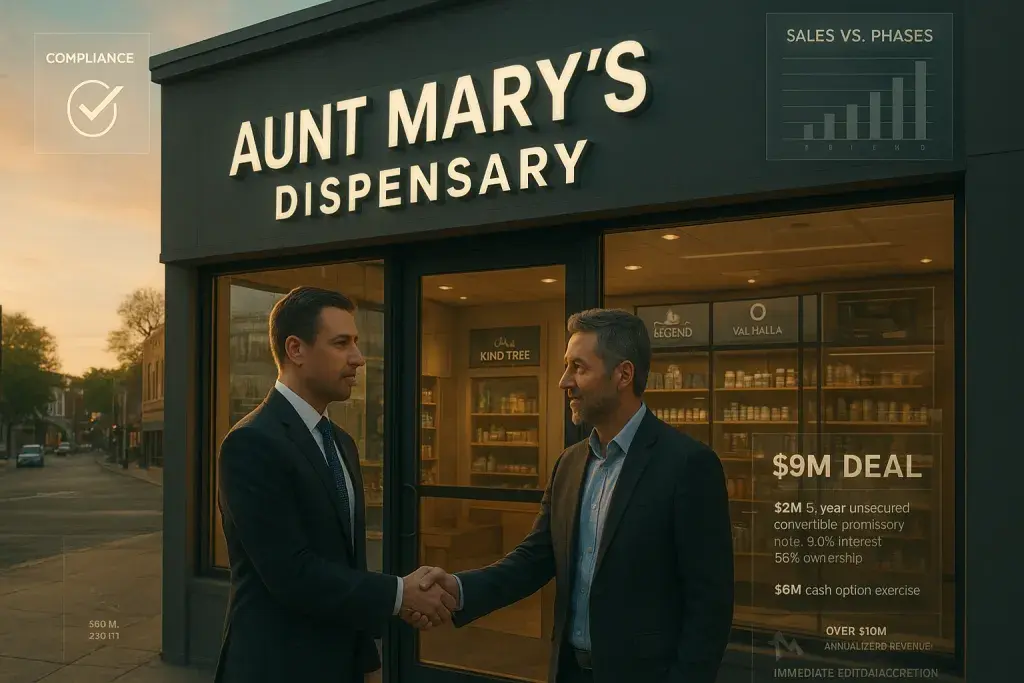
TerrAscend Corp. has signed an option agreement to purchase Aunt Mary's Dispensary in Flemington, New Jersey - a move that would give the multi-state operator five licensed retail locations in the state and add a dispensary generating more than $10 million in annualized revenue to its books. The transaction, structured as a two-part payment totaling $9 million, is expected to be immediately accretive on both an EBITDA and free cash flow basis. Regulatory approval is still required before the deal closes.
The structure itself is worth unpacking. TerrAscend is paying $3 million via a five-year unsecured convertible promissory note at 6.0% interest to secure an option on 35% of Aunt Mary's, with an additional $6 million in cash due upon exercising that option. It's a phased approach - one that limits upfront capital exposure while locking in the right to close. Operators in mature cannabis markets are increasingly creative with deal architecture like this, particularly as traditional financing remains difficult for plant-touching companies. For context, operators in other regulated markets looking to replicate similar growth plays - including those building out retail footprints with strong point-of-sale infrastructure, like cannabis POS for Virginia dispensaries - understand that back-office readiness and financial structure go hand in hand when scaling retail locations under state oversight.
Aunt Mary's opened in February 2023 and occupies 5,200 square feet of retail space in a high-traffic corridor in Flemington, Hunterdon County. The dispensary operates with limited nearby competition - a material advantage in a state where license caps and zoning restrictions shape the competitive geography more than consumer demand alone. At more than $10 million in annualized revenue from a single location, the unit economics here are strong by any reasonable measure of cannabis retail performance.
What Vertical Integration Actually Does for the Margin Math
TerrAscend's Executive Chairman Jason Wild specifically cited vertical integration as a margin opportunity. That's not boilerplate. In New Jersey, licensed cannabis operators with cultivation and manufacturing capabilities can supply their own retail shelves - cutting out wholesale markup, controlling product availability, and prioritizing their own SKUs in the budroom inventory mix. When an MSO acquires a third-party dispensary, one of the first operational levers it pulls is shifting the wholesale purchasing relationship inward.
The company's brand portfolio - Kind Tree, Legend, Valhalla, and Cookies - would be introduced at Aunt Mary's following close. From a retail operations standpoint, that means SKU rationalization, planogram changes, staff training on new product lines, and potentially adjustments to the POS configuration to reflect updated pricing tiers and compliance tagging requirements. None of that is trivial, but for an MSO with established supply chain infrastructure, it's executable. The bigger question is how quickly those brand introductions translate to improved gross margin at the store level - and whether the existing customer base, built under independent ownership, absorbs the transition without attrition.
New Jersey's Regulatory Framework and the Social Equity Angle
TerrAscend's announcement noted that the transaction "conforms to New Jersey's regulatory framework, which facilitates investment opportunities for diversely owned businesses." That language points to a specific regulatory mechanism - New Jersey's Cannabis Regulatory Commission has established pathways that allow larger operators to invest in or partner with diversely owned licensees under defined conditions. It's a structure designed to balance capital access for social equity and minority-owned businesses against the risk of those operators being absorbed or displaced by well-capitalized MSOs.
The deal's compliance with that framework matters beyond this transaction. New Jersey regulators have been deliberate about the pace and structure of MSO expansion, and any acquisition that runs afoul of diversely-owned business protections could draw scrutiny. The option structure - granting TerrAscend a right to purchase rather than an immediate full acquisition - may reflect, in part, a deal architecture designed to satisfy those regulatory conditions. That's not unusual; in other states with similar frameworks, staged investment agreements have become standard tools for MSOs entering the market through independent operators.
What This Signals for TerrAscend's New Jersey Strategy
Five dispensaries in a single state is a meaningful retail concentration. New Jersey remains one of the more competitive adult-use markets on the East Coast, and operating density at this level gives TerrAscend real advantages - shared logistics, consolidated compliance reporting, brand consistency across locations, and the kind of local market knowledge that comes from managing multiple storefronts within a single regulatory jurisdiction.
Wild's statement that the company "remains active in evaluating additional opportunities to expand our retail footprint" suggests this isn't the last deal of this type. For wholesale brands, real estate landlords with cannabis-zoned properties, and ancillary vendors operating in New Jersey, that's a signal worth tracking. MSOs at this scale tend to centralize purchasing decisions, which can reshape wholesale relationships quickly. An independent brand that was doing strong volume through Aunt Mary's, for instance, may find that shelf space reallocated once TerrAscend's house brands move in - a common and commercially rational outcome that independent producers in any consolidated retail market know well. The dispensary business, in that respect, isn't so different from any other regulated retail vertical where scale rewrites the terms of trade.