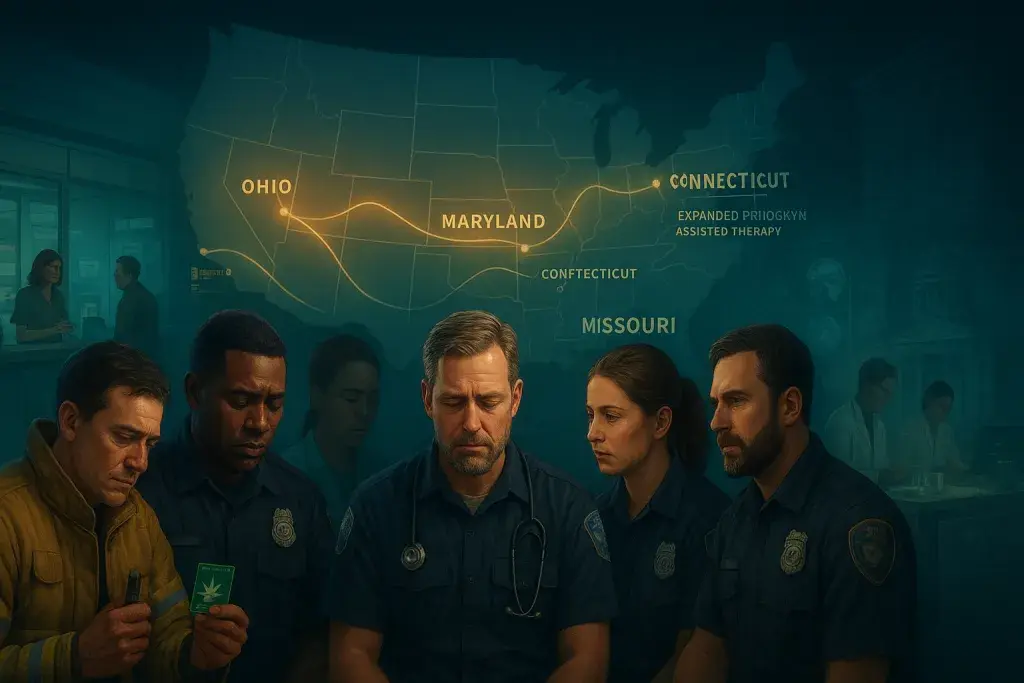
A quiet but consequential policy shift is taking shape across several states: legislatures and governors are moving beyond traditional counseling and medication to address post-traumatic stress in firefighters, police officers, and emergency medical workers. Ohio, Maryland, Connecticut, and Missouri have all advanced distinct measures this year - ranging from treatment funding commissions to employment protections for registered medical cannabis patients - signaling that the regulatory environment around first responder mental health is in active flux.
For licensed cannabis operators, the Maryland law deserves particular attention. Effective October, it prohibits employment discrimination against firefighters, EMTs, paramedics, and other rescue workers who are registered medical cannabis patients and test positive for cannabis metabolites while off duty - provided they are not impaired on the job. That is a meaningful legal distinction, and dispensaries in states that border Maryland or serve similar patient populations should be thinking about what it means for their compliance frameworks and patient intake protocols. Point-of-sale systems that track patient registry status and purchase history will matter here; operators relying on their platform to manage medical cannabis workflows should verify that documentation capabilities align with evolving state-level employment protection laws, which increasingly require that dispensaries can demonstrate a patient was a lawful, registered user at the time of any challenged transaction.
Jason Cerrano, a retired firefighter and paramedic with more than 20 years of experience in Missouri who now directs commercial research and development at IDEX Fire & Safety, put the psychological reality of first responder work plainly: "When you are in the fire service, or any first responder industry, or especially in the military, stuff builds up over time, and what happens is you see so many things that the crazy stuff starts to at least seem normal." That framing matters because it explains why single-session counseling or short-term prescriptions often fall short - and why states are now casting a wider net.
The Regulatory Divergence Worth Tracking
Each state is taking a different angle, and that divergence is not incidental. Ohio's approach - a Post-Traumatic Stress Injury Commission to review first responder applications for treatment cost assistance - is essentially a funding and access mechanism. It does not change the legal status of any specific treatment. Maryland's law is primarily an employment protection. Connecticut expanded a psilocybin-assisted therapy pilot at Yale University, opening it to any state resident 18 or older who meets clinical eligibility criteria established by the university's institutional review board, after it was previously limited to veterans, retired first responders, and frontline health care workers. Missouri's legislature advanced a bill that would allow veterans and first responders in approved research studies to receive psilocybin and ibogaine under medical supervision - but the legislature adjourned in May before the bill reached the governor's desk.
Here's the catch: none of these are uniform, and none of them create a single compliance template that multi-state operators or medical cannabis suppliers can apply wholesale. What they do collectively signal is that state-level treatment frameworks are beginning to accommodate substances - cannabis and otherwise - that sit outside the traditional pharmaceutical and counseling model. For medical cannabis licensees, that is a market and regulatory opportunity, but it comes with compliance exposure that demands attention.
What This Means for Medical Cannabis Licensees
Maryland's employment protection law does not expand who can access medical cannabis. It protects registered patients from losing their jobs for lawful off-duty use. The operational implication for dispensaries is subtle but real: patient-facing staff - budtenders, intake coordinators, patient care specialists - need to understand that the populations they serve may now have statutory employment protections tied to their patient status. That is a compliance and training issue, not just a marketing talking point.
More broadly, as states experiment with emerging therapies for PTSD - including psychedelics that remain federally scheduled - the regulatory scaffolding being built around first responder mental health creates a precedent for how states think about alternative treatments. Medical cannabis operators who engage early with public health stakeholders, employee assistance program administrators, and first responder unions may find themselves better positioned as these frameworks mature. That is not a prediction; it is a straightforward reading of how regulated markets develop when policy moves ahead of federal consensus.
What's striking here is the speed at which employment protections for medical cannabis patients are moving at the state level, independent of any federal rescheduling action. Maryland is not alone. Several states have enacted similar protections in recent years, and the legal theory - that a registered patient who is not impaired on duty should not face adverse employment action for off-duty lawful use - is gaining traction in legislatures that would have found it politically untenable not long ago. For dispensary operators, compliance officers, and the POS and seed-to-sale software vendors that serve them, that trajectory is worth building into long-term product and policy roadmaps now.