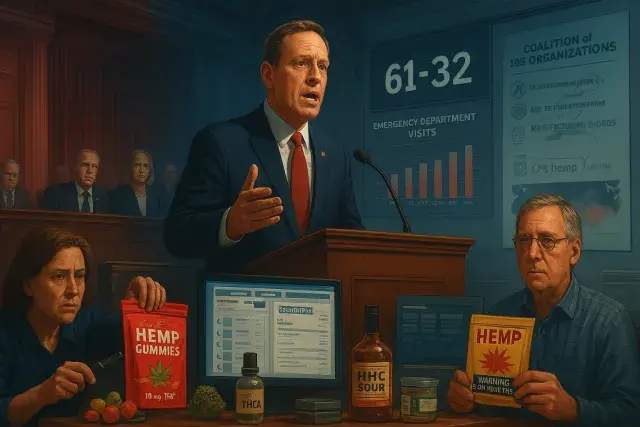
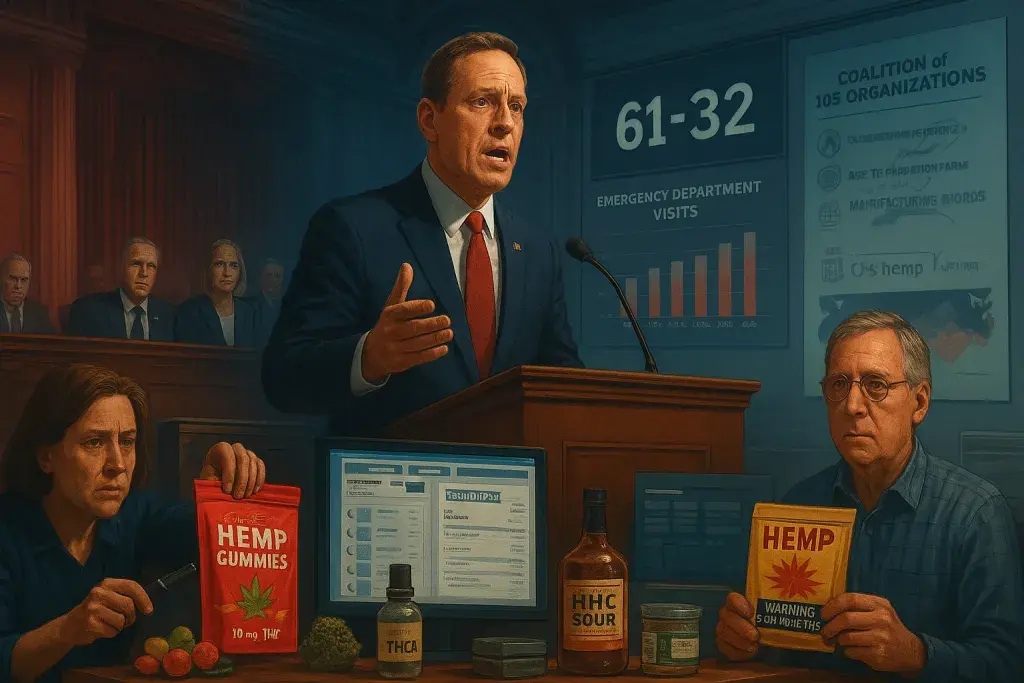
A one-month reprieve on federal hemp restrictions survived a Senate challenge last week, but the margin of victory tells operators little about where this market lands by year's end. Sen. Ted Budd, R-N.C., tried and failed to strip a 30-day delay from the chamber's continuing resolution, a move that would have kept a Nov. 12 effective date for sweeping new THC limits fully intact. Senators voted 61-32 to table his amendment, meaning the delay holds - for now - pushing the effective date to Dec. 11.
For dispensary owners, convenience store chains, and hemp-derived beverage brands, that four-week difference is not a technicality. It is the gap between planning a compliant fall product lineup and pulling SKUs off shelves with almost no notice. Retailers operating across state lines, particularly in markets like North Carolina and South Carolina where hemp-derived products have filled gaps left by slow-moving cannabis legalization, are watching this fight closely because it determines how much runway remains before total-THC caps reshape wholesale menus. Multi-location operators already relying on dispensary software in South Carolina to track inventory and compliance logs know how quickly a shifting regulatory calendar can turn a stable product catalog into a liability.
The underlying law, passed in November 2025, redefines hemp to account for total THC rather than delta-9 THC alone, and it caps finished products at 0.4 milligrams of combined THC and similar cannabinoids per container. That threshold effectively removes most intoxicating hemp beverages, gummies, vapes, and THCA flower from ordinary retail shelves - the products Budd argues have been marketed with packaging that mimics candy and snack brands.
A Public-Safety Argument Meets an Industry Coalition
Budd framed his push in blunt terms, citing North Carolina emergency department data showing cannabis-related visits among minors rose sharply between 2017 and 2025. His argument: Congress already voted to close what he calls the hemp loophole nine months ago, and further delay simply protects a business model built on unregulated retail access. That message resonated with a bipartisan bloc of 32 senators, including Thom Tillis, Kirsten Gillibrand, and Mitch McConnell, but it wasn't enough to overcome the tabling motion.
On the other side, a coalition of 105 organizations - including the US Hemp Roundtable, the National Association of Convenience Stores, and several North Carolina hemp and brewing groups - pushed for the delay, arguing that 30 extra days gives Congress time to legislate real guardrails: age verification, restrictions on synthetic cannabinoid imports, and manufacturing standards, rather than a blunt-instrument ban. That's the tension running through this entire debate. Nobody serious is defending an unregulated market selling look-alike edibles to teenagers. The argument is over whether a strict THC ceiling is the right compliance tool or whether it just eliminates a category of products wholesale, taking legitimate operators down with the bad actors.
North Carolina's Parallel Deadlock Adds Pressure
The federal fight has a mirror image in Raleigh. House Bill 328 would import much of the same 0.4-milligram threshold directly into state law, meaning North Carolina's restriction could survive even if Congress delays or rewrites the federal standard. The Senate passed a conference report 37-6 in early July, but the House has repeatedly declined to act, leaving the bill parked in the Rules Committee. House Speaker Destin Hall has acknowledged lawmakers broadly agree the current unregulated market can't continue, but disagreement over the fix - outright prohibition versus a licensing and testing framework - has stalled action.
For operators, this is the real operational risk: a compliance deadline that keeps moving, layered across federal and state jurisdictions that aren't necessarily aligned. Inventory planning, wholesale contracts, and lab testing protocols built around one deadline may need to be rebuilt around another within weeks. Retailers who treat this as a one-time compliance event are underestimating how unsettled the legal definition of "hemp" remains heading into December.