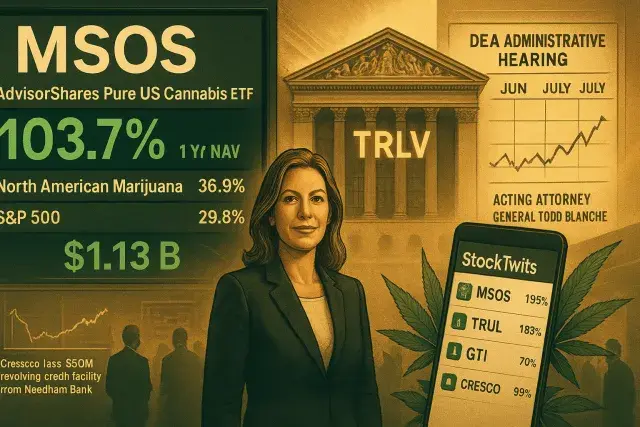
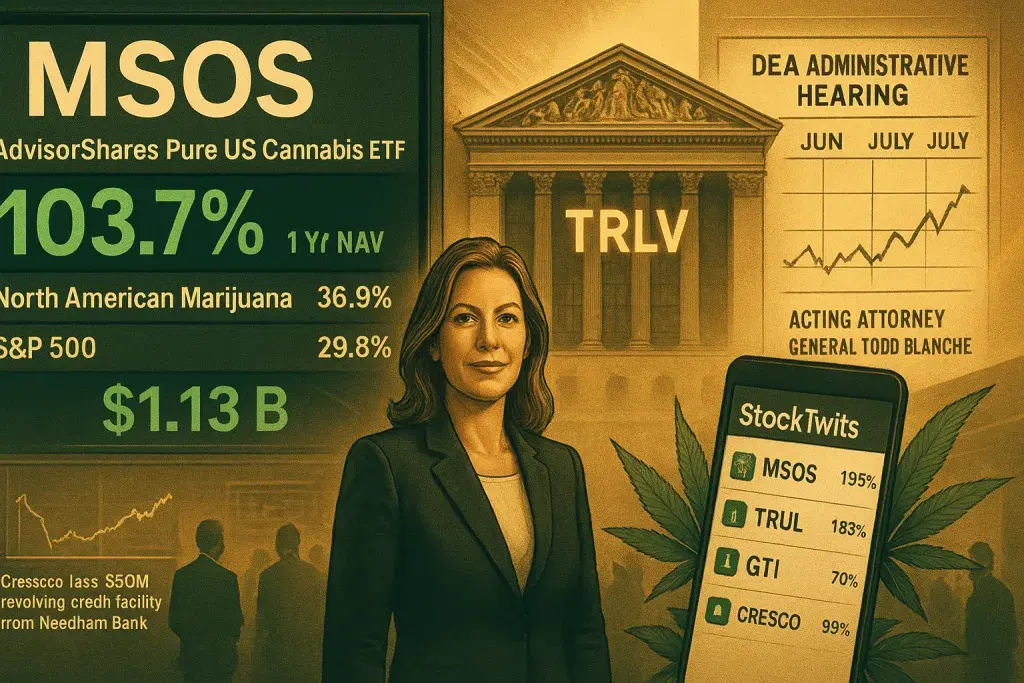
Money is flowing into cannabis equities at a pace this sector hasn't seen in years, and the numbers tell the story plainly. The AdvisorShares Pure US Cannabis ETF (MSOS) posted a 103.7% one-year net asset value return as of May 31, more than double the North American Marijuana Index's 36.9% gain and well ahead of the S&P 500's 29.8% return. With $1.13 billion in assets as of June 5, the fund has become the clearest proxy for how institutional and retail money is pricing the odds of federal cannabis reform.
The catalyst everyone's watching sits on the calendar: a DEA administrative hearing set for June 29, expected to run through mid-July, that will examine whether marijuana products broadly - not just state-licensed medical cannabis - should move to Schedule III. That follows an April decision by Acting Attorney General Todd Blanche to reclassify medical marijuana products, a move that eliminated punishing 280E tax treatment for licensed medical operators and let them deduct ordinary business expenses like payroll and rent for the first time. Trump's recent nomination of Blanche to serve as attorney general permanently has only sharpened investor attention on where this process heads next. For operators managing multi-state footprints, the compliance stakes extend well past taxation - inventory tracking, delivery manifests and point-of-sale integration all get more complex as markets expand, which is part of why software providers like the ones behind cannabis delivery software rhode island have become quietly essential infrastructure rather than a back-office afterthought. cannabis delivery software rhode island
Trulieve's NYSE Listing Signals a Structural Shift
Trulieve Cannabis, MSOS' largest holding at just over 30% of assets, began trading on the NYSE under the ticker TRLV this week. CEO Kim Rivers called it a "historic milestone," and the mechanics behind it matter for the whole industry: Trulieve separated its medical cannabis operations from its adult-use business specifically to qualify for a senior U.S. exchange listing. That's not a cosmetic corporate move. Uplisting from over-the-counter markets to a major exchange typically widens access to institutional capital, improves trading liquidity, and can lower the cost of raising money - all things multi-state operators have struggled with under federal prohibition. Alliance Global maintains a Buy rating on Trulieve, pointing to its concentration in medical-only states and exposure to expanding markets like Texas and Georgia as a distinct advantage heading into the hearing.
Financing Deals Show the Rescheduling Bet in Practice
The theoretical benefits of Schedule III are already showing up in deal flow. Cresco Labs secured a $50 million revolving credit facility from Needham Bank this week, with CEO Charlie Bachtell describing it as a "powerful, non-dilutive tool" to fund acquisitions and position the company for eventual uplisting. Tilray Brands, though not an MSOS holding, has signaled it may use proceeds from a recent at-the-market offering for acquisitions and expansion. Roth Capital called the rescheduling order "extremely favorable," citing improved capital access, taxation relief, and better sector investability. In practice, though, none of this changes the operational basics dispensaries and cultivators still answer to day to day: seed-to-sale tracking through state systems, lab testing and COA verification, compliant packaging, and age-gated retail sales remain fully intact regardless of what happens with federal scheduling.
Where the Market Sees the Most Upside
Trulieve gets the headlines, but it isn't where analysts see the biggest re-rating potential. Verano carries an estimated 195% upside based on current price targets, followed by Jushi Holdings at 183% and Cresco Labs near 99%. Among the larger holdings, Green Thumb Industries stands out with 70% upside, ahead of both Trulieve and Curaleaf. Retail sentiment on platforms like Stocktwits has run "extremely bullish" across MSOS, Trulieve and Green Thumb tickers, with heavy message volume - a signal that enthusiasm has spread well past institutional desks.
- MSOS one-year NAV return: 103.7%, versus 36.9% for the marijuana index and 29.8% for the S&P 500
- DEA hearing on broader rescheduling begins June 29, expected to conclude by mid-July
- Trulieve separated medical and adult-use operations to qualify for NYSE listing under TRLV
- Cresco Labs' $50 million credit facility reflects early financing benefits tied to Schedule III
None of this settles the underlying question. A hearing isn't a ruling, and Schedule III doesn't legalize cannabis federally or resolve the patchwork of state licensing, taxation and banking rules operators navigate daily. What it does, if it goes the industry's way, is remove some of the tax and capital penalties that have made cannabis retail one of the toughest regulated businesses to run profitably. That's worth watching closely - but it's a policy and market story, not a reason to treat cannabis stocks, or cannabis products themselves, as a sure thing.