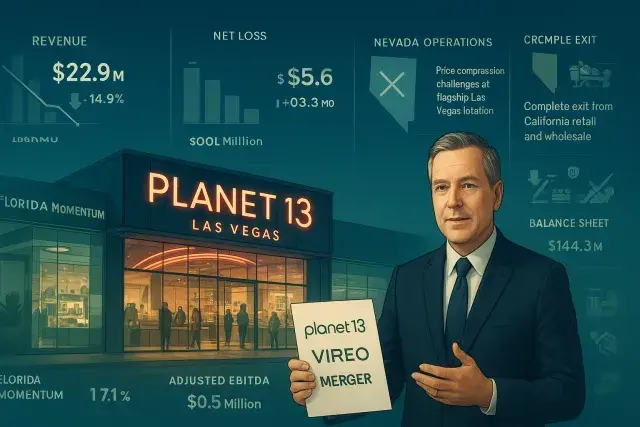
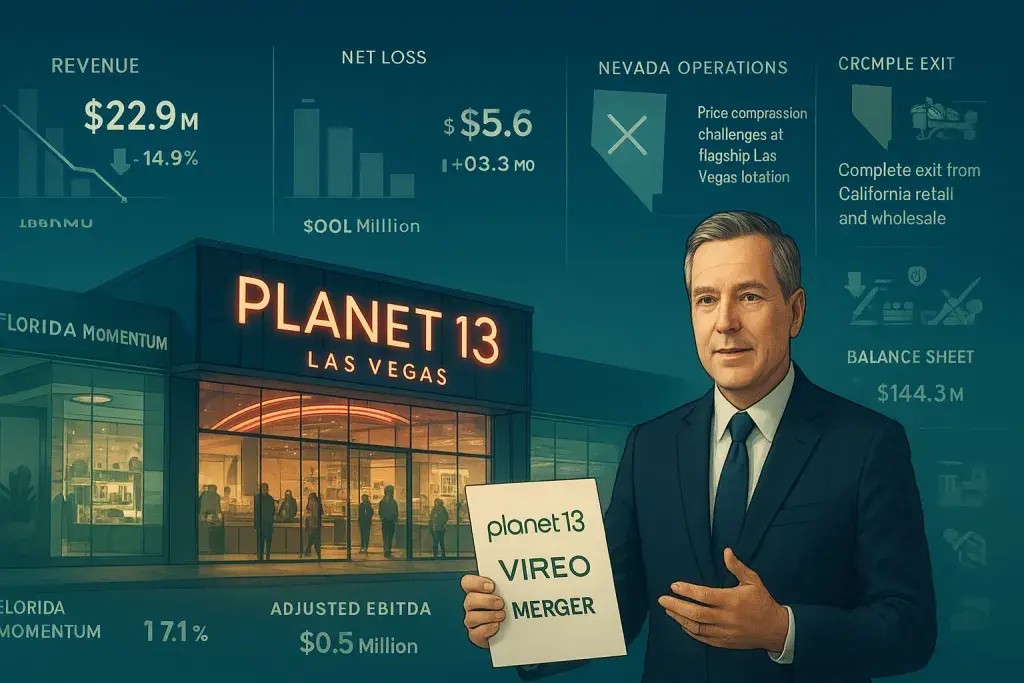
Planet 13 Holdings reported second-quarter 2026 revenue of $22.9 million, down 14.9% from a year earlier, but the multi-state operator managed to shrink its net loss to $5.6 million from $13.3 million and cut its Adjusted EBITDA loss to $0.5 million from $2.4 million. The results, disclosed August 12, arrive as the company works toward closing its previously announced merger with Vireo Growth Inc., a deal that reshapes how investors should read this quarter's numbers.
Margin Gains Despite a Smaller Top Line
Here's the catch with this report: revenue fell, yet gross margin actually improved to 53.9% from 43.4%. That's not a contradiction so much as a deliberate trade-off. Planet 13 exited California retail and wholesale operations entirely, a market that had been dragging on margins amid persistent wholesale price compression. Removing that exposure, combined with company-wide procurement initiatives, lifted the blended margin even as total dollars sold declined. A $1.0 million reduction in the company's inventory reserve for Florida distillate also flattered the quarter; strip that out and gross margin still came in at 49.5%, a meaningful improvement on its own. For operators watching their own SKU mix, the lesson is familiar: shedding low-margin volume can improve the health of a P&L statement even when top-line growth stalls.
Florida Momentum, Nevada Headwinds
Florida revenue rose 17.1% quarter over quarter, a sign that the company's efforts to stabilize that market are gaining traction. Planet 13 also secured OMMU approval in May for a Florida BHO extraction facility, adding in-house concentrate production capacity ahead of the state's continued rollout of adult-use ballot efforts and medical program expansion. A Sarasota store announcement in July signals continued footprint growth there, even as Nevada - long the company's flagship market centered on its Las Vegas superstore - continues to face the same price compression squeezing operators across mature adult-use states. Total expenses fell 17.7% to $15.2 million, reflecting cost-cutting that touched labor, procurement and overhead simultaneously rather than a single line item.
What the Vireo Merger Means for Shareholders and Operators
The July 27 merger agreement with Vireo Growth is the real story sitting underneath these numbers. Co-CEO Bob Groesbeck framed the deal plainly: the market increasingly rewards scale, purchasing power, broader distribution and a balance sheet capable of absorbing continued price compression. That's a candid admission from operator leadership, and it tracks with what multi-state cannabis operators have been signaling for a while - standalone scale in Nevada, Illinois and Florida isn't enough on its own to offset margin pressure in maturing adult-use markets. Because the merger is pending, Planet 13 opted not to hold its usual earnings conference call this quarter, a procedural detail but a telling one; management's attention is now split between running current operations and executing a clean transition.
Balance Sheet and What Comes Next
Total assets stood at $144.3 million versus $152.3 million at year-end 2025, while total liabilities rose slightly to $105.5 million from $101.2 million. Cash and restricted cash ticked up modestly to $16.5 million. None of these figures signal distress, but they underscore why combining with a larger platform has appeal: 280E tax exposure, compliance overhead, and the cost of maintaining vertically integrated cultivation, extraction and retail operations across three states weigh differently on a smaller balance sheet than a larger one. For dispensary operators and suppliers watching multi-state consolidation trends, Planet 13's quarter is a data point in a broader pattern - margin discipline and portfolio pruning now, scale-driven efficiency later.