
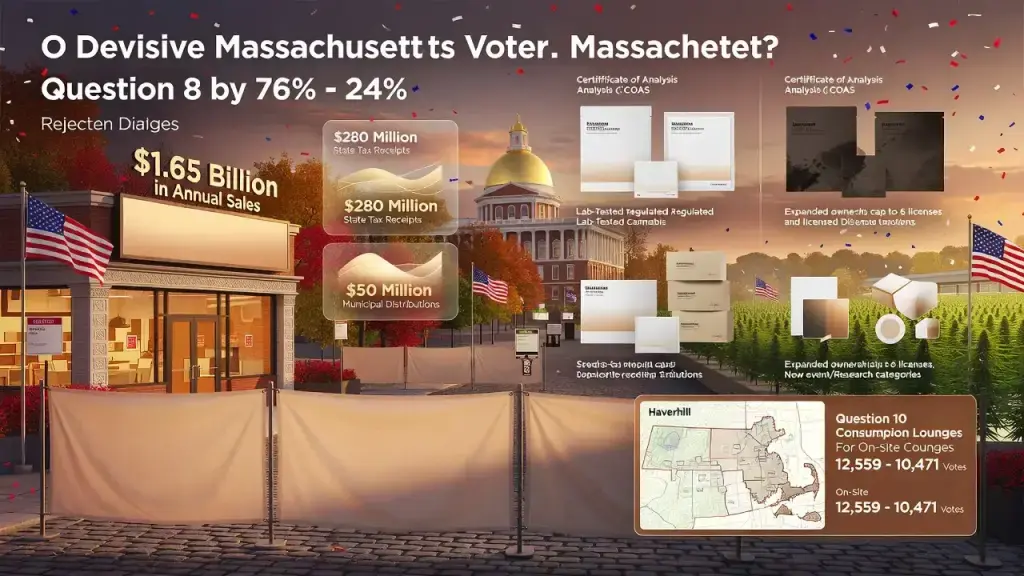
Massachusetts voters delivered a lopsided verdict on Tuesday, rejecting Question 8 by a roughly 76% to 24% margin, according to unofficial returns. The result keeps the state's licensed adult-use cannabis system in place - a market the state says generated more than $1.65 billion in sales last year - and closes out one of the more consequential ballot fights the industry has faced since legalization took effect.
For dispensary operators, cultivators, and the vendors who supply them, the outcome removes a looming existential threat. Had voters gone the other way, the clock would have started ticking toward a hard shutdown of the regulated retail system on January 1, 2028.
What Repeal Would Have Actually Done
Question 8 wasn't a minor tweak. It would have unwound the statutory framework governing adult-use licensing and taxation entirely, while also eliminating legal home cultivation. The medical marijuana program would have survived, and the measure included a landing pad of sorts - adult-use licensees could have sought expedited medical dispensary licenses and sold off remaining inventory to those dispensaries. That sounds tidy on paper, but in practice, a multi-year wind-down of a billion-dollar retail channel carries enormous operational weight: lease obligations, payroll, vendor contracts, compliant packaging inventory, and seed-to-sale tracking data all would have needed an orderly exit plan rather than a cliff.
The fiscal stakes were concrete. State analysts pegged fiscal year 2025 tax receipts from adult-use sales at roughly $280 million for the Commonwealth and another $50 million distributed to municipalities. That revenue stream - generated through excise and sales tax on licensed transactions - was the backbone of the Coalition for a Healthy Massachusetts' opposition case, though the group framed its argument around public health and safety concerns rather than fiscal ones.
The Illicit Market Argument Carried the Day
Operators and the Massachusetts Cannabis Coalition pushed back hard on the public-safety framing, arguing that shuttering licensed retail wouldn't eliminate demand - it would just redirect it. That's the core tension in cannabis policy debates nationally: licensed channels carry lab testing requirements, certificates of analysis, and labeling standards that unlicensed sellers simply don't follow. Strip away the regulated option and consumers don't stop buying; they shift toward products with no COA behind them at all. The vote suggests Massachusetts voters found that argument more persuasive than the repeal campaign's public-health framing, though exit-poll detail on voter reasoning isn't part of the record here.
What Stays in Place, and What Changes Next
With Question 8 defeated, a separate cannabis reform law signed by Governor Maura Healey earlier this year remains the operative framework for near-term change. That legislation raised the per-owner retail license cap from three to six - a meaningful shift for operators pursuing vertical integration or regional footprint growth - and widened the adult possession limit. It also opened the door to new license categories covering on-site consumption, event-based use, and research, categories that didn't previously exist in the state's regulatory structure.
That last piece is already playing out locally. In Haverhill, voters approved Question 10, authorizing licensed on-site cannabis consumption by a margin of 12,559 to 10,471 in unofficial results. The local vote matters beyond Haverhill because it satisfies a municipal approval requirement built into the state's social consumption rules, which took effect in January. Operators eyeing consumption-lounge licenses in other municipalities should expect similar local referendum hurdles before state approval becomes workable - a reminder that statewide policy wins don't automatically translate into a green light at the local zoning and ballot level.
The Operational Takeaway
- Licensed retailers retain regulatory continuity, avoiding a forced wind-down of inventory, leases, and compliance systems.
- The ownership cap increase from three to six licenses could accelerate consolidation among multi-store operators.
- New license categories for on-site consumption and events will likely move through local approval processes similar to Haverhill's, municipality by municipality.
- Tax revenue tied to adult-use sales remains a budget line for both the state and local governments, reinforcing the fiscal argument for keeping the licensed channel intact.
Fair enough to call this a decisive result rather than a close call. But the bigger signal for operators elsewhere is that voters, when presented with a straightforward choice between a regulated, tested, taxed market and a return to unregulated sales, didn't treat it as a close question.