With Kansas's August 4 primary approaching, cannabis legalization has become one of the sharpest dividing lines between gubernatorial candidates - and for licensed operators and prospective dispensary businesses watching from neighboring states, the stakes are concrete. Kansas remains one of a dwindling number of states where cannabis is not legal in any form, even for medical use, leaving a significant consumer market and its associated tax revenue effectively exported to Missouri, Oklahoma, and other adjacent legal markets.
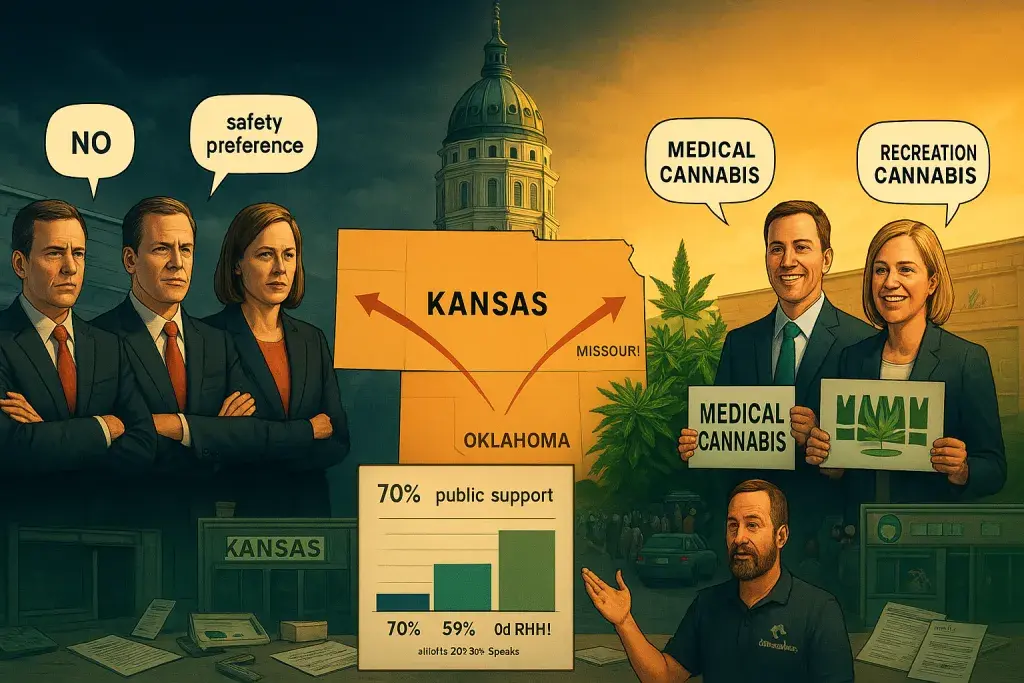
A 2025 Kansas Speaks survey found that 70% of Kansans support legalizing medical cannabis, including 59% of Republicans - a figure that matters because it exposes a gap between the state's electorate and its Republican gubernatorial field. None of the GOP candidates have backed legalization in any form. For operators and market observers tracking state-by-state expansion, the Kansas situation echoes dynamics seen in other late-adopting states, where legislative inertia outlasts public opinion by years. How neighboring legal markets have structured their retail and licensing frameworks offers instructive comparisons; read more on how one such adult-use market built out its compliance and retail infrastructure from a medical-only foundation.
Brett Harris, owner of KannaBliss, put the business case plainly. "The economic impact this flower could actually have on the state of Kansas is actually huge. We're seeing people driving to Missouri, to Oklahoma," he said, adding: "If you're a Republican candidate and you're looking at this graph, at what point do you wake up?" That cross-border leakage isn't just a talking point - it's a measurable drag on in-state retail sales tax, excise tax, and license fee revenue that a regulated adult-use or medical framework would otherwise capture. Missouri's legalization, in particular, has positioned it to absorb demand from unserved Kansas consumers, and that pattern is familiar to anyone who has watched border-state retail economics play out in the Midwest.
Where the Candidates Actually Stand
The Republican field's positions range from dismissive to blunt. Ty Masterson said the issue lacks support in Topeka; Scott Schwab framed prohibition as a safety preference; Charlotte O'Hara offered a single word - "No" - when asked about any use at all; Philip Sarnecki opposed both recreational and medical legalization. Two other Republican candidates, Phil Sarnecki and Nick Reinecker, had not responded to press inquiries at the time of this report.
Democratic candidates Ethan Corson and Cindy Holscher both support legalizing medical and recreational cannabis. Corson pointed to tax revenue; Holscher called it a sensible policy step. A third Democratic candidate expressed support for medical legalization while calling for careful regulatory design - a framing that will sound familiar to compliance professionals who have watched states struggle to build workable seed-to-sale tracking systems, licensing structures, and testing requirements after moving too quickly.
The Regulatory and Operational Gap Kansas Would Need to Close
Here's the catch that candidates on both sides of the issue rarely address in detail: building a functional medical or adult-use cannabis market isn't just a legalization vote. It requires a regulatory infrastructure - licensing frameworks, testing lab certification, compliant packaging standards, point-of-sale system requirements, METRC or equivalent seed-to-sale tracking, excise tax structures, and zoning rules that municipalities then have to implement. States that have legalized without that groundwork in place have faced inventory tracking failures, unlicensed operator proliferation, and consumer safety lapses that damaged public trust in regulated markets.
The third Democratic candidate's caution about regulation is worth taking seriously as a business matter, not just a political hedge. Operators who have built compliant retail operations in functional medical markets know that a poorly drafted regulatory rollout can create licensing backlogs, testing bottlenecks, and compliance costs that strain small licensees disproportionately. If Kansas eventually moves - under whichever party - the design of its regulatory framework will determine whether the market is viable for small operators or tilts toward well-capitalized multi-state operators who can absorb startup compliance costs.
What the Political Calculus Means for the Industry
Harris's assertion that Republican candidates are making a political miscalculation has a specific business implication attached to it. If a Democrat wins the governorship partly on a cannabis platform, the downstream expectation - among investors, prospective licensees, and out-of-state operators scouting expansion - will be for legislative momentum toward at minimum a medical framework. That expectation shapes real decisions: whether a multistate operator begins site-selection work in Kansas, whether ancillary vendors begin building state-specific compliance tools, whether real estate in potential dispensary corridors attracts early commercial interest.
None of that is guaranteed. A governor's support doesn't move a bill through a Republican-controlled legislature, and Kansas's legislative dynamics would shape the actual timeline for any licensed market. But the political signal matters. Operators in neighboring legal states have watched this cycle repeat: public opinion runs well ahead of political action, a legalization advocate wins a statewide race, and then the hard work of regulatory design begins - often slower and messier than the campaign promised. Kansas isn't there yet. Whether the August primary and November general election move it closer is a question every licensed business with regional ambitions has reason to watch.