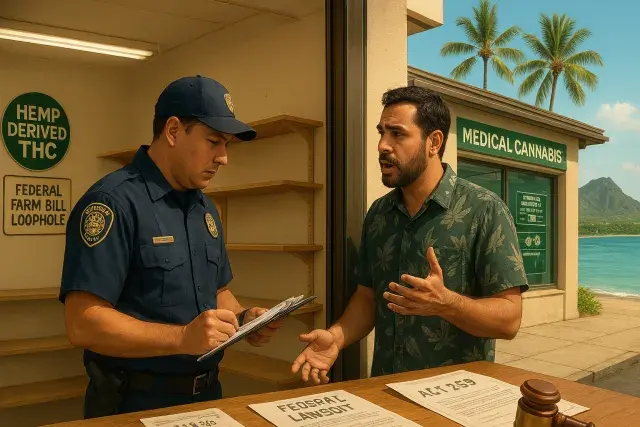
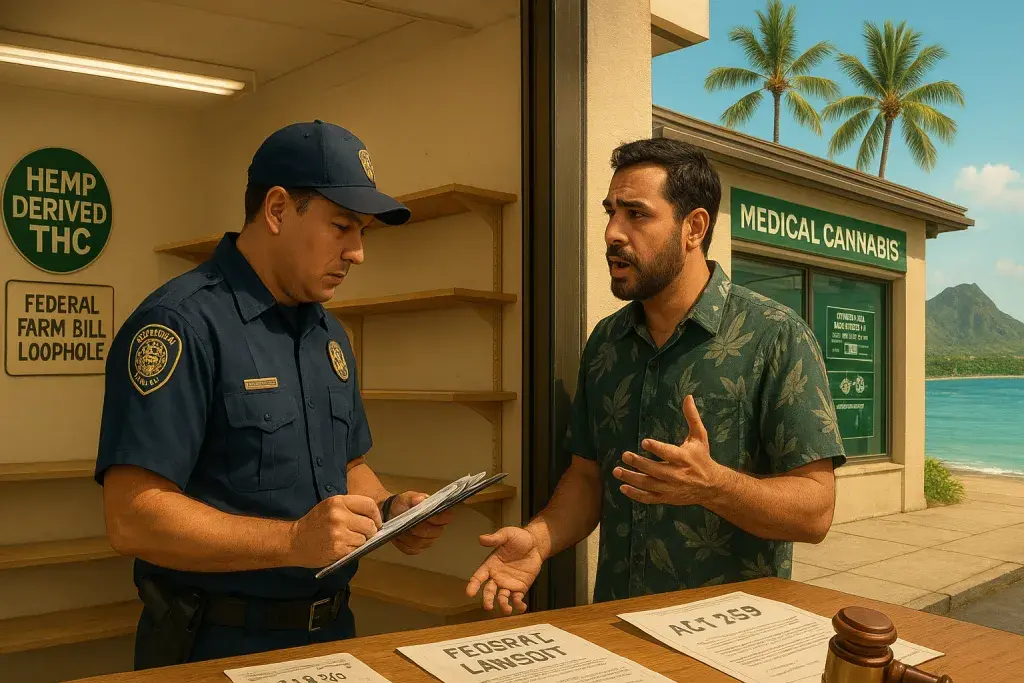
Shelves that once held pre-rolled hemp cigarettes and THC gummies at unlicensed shops across Oʻahu are now bare, the result of a Hawaiʻi Department of Health enforcement push that began in July. The agency is using new registration authority under Act 269 to inspect retailers and order them to pull hemp-derived cannabinoid products that state law never actually authorized for sale. For operators who built retail models around federally legal hemp, the crackdown has turned into an existential threat almost overnight.
The underlying tension is one that regulators in nearly every legal cannabis market have wrestled with: how do you police a product that Congress made legal at the federal level but that a state never cleared for retail sale? Hawaiʻi's 2020 hemp law permitted cultivation but stopped short of authorizing hemp-derived THC products for the retail shelf, leaving a gap that hundreds of shops nationally - and dozens on Oʻahu alone - walked through anyway. That gap is now closing, and it's forcing operators to reckon with compliance infrastructure many never built. Multi-location retailers in fully regulated markets typically run on far more rigorous back-end systems - inventory tracking, batch-level compliance logs, integration with platforms like Ontario seed-to-sale dispensary software - precisely because regulators expect full traceability from cultivation to point of sale. Hemp retailers operating under the farm bill loophole largely didn't need any of that, which is part of why the sudden pivot to registration and inspection has been so disruptive. Ontario seed-to-sale dispensary software
A Two-Track Market Collides
Hawaiʻi's licensed medical dispensary system caps the number of operators at eight, each permitted multiple retail locations under conditions tied to underserved or rural markets. That structure, in place for a decade, created a de facto oligopoly - and licensed operators argue they've absorbed costs the unregulated hemp shops never faced: mandatory lab testing, compliant packaging, seed-to-sale tracking, and the tax burden that comes with operating a federally scheduled substance under 280E. When cheaper, untested hemp-derived products flooded the market, patient enrollment in the medical program dropped by roughly 16% over several years, according to state figures, and licensed dispensaries lost significant wholesale and retail volume to shops that faced none of the same compliance overhead.
That's the argument driving the new enforcement rules. It's also exactly what unlicensed retailers like Oʻahu Dispensary and Provisions dispute in federal court, where owner Lance Alyas has sued to block the crackdown, arguing it improperly recriminalizes hemp that Congress legalized and unlawfully interferes with interstate commerce. The state's countering that its authority to regulate retail sale within its borders isn't preempted by federal hemp policy - a distinction that matters enormously for any operator trying to figure out where the legal line actually sits.
What Operators and Suppliers Should Take From This
The practical lesson for retailers outside Hawaiʻi is not subtle: a federal legal status does not guarantee a state retail pathway, and state agencies can and will require registration, inspection access, and product-level compliance once they decide to enforce. Wholesalers supplying hemp-derived beverages, vapes, or edibles into any state should assume that COAs, batch testing, and clear labeling are the baseline expectation, not a courtesy.
- Registration and inspection authority can be granted to health regulators even without a full licensing overhaul
- Hemp-derived THC products sold outside licensed medical or adult-use channels carry real regulatory exposure regardless of federal legality
- Consumer-facing brands should expect that marketing tone - lifestyle branding versus medical framing - will draw scrutiny from lawmakers weighing new rules
- A pending federal redefinition of hemp, signed into law in 2025 and expected to take effect in December, could reshape or eliminate the loophole that created this entire market segment
Whether Hawaiʻi's approach survives its federal court challenge or gets overtaken entirely by the new federal hemp definition, the underlying pressure isn't going away. States are increasingly unwilling to let hemp-derived intoxicants sit outside the compliance frameworks built for regulated cannabis, and operators betting their business model on a persistent loophole should treat that bet as a short one.