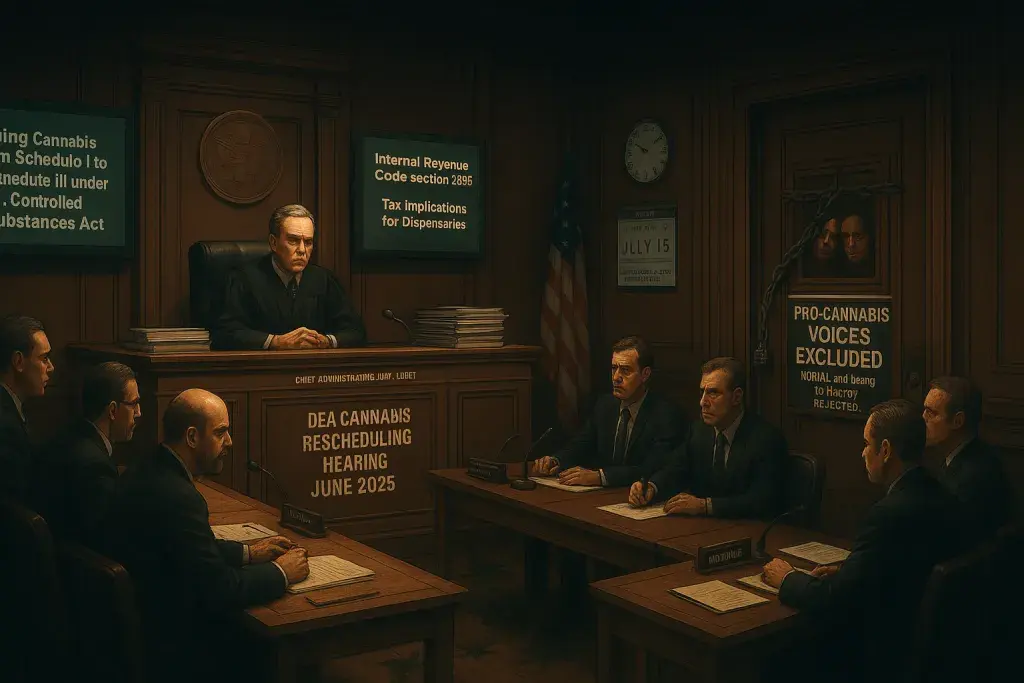
The DEA's cannabis rescheduling hearing now has a formal schedule, a locked participant list, and a hard deadline - and the process looks nothing like what the industry expected a year ago. Chief Administrative Law Judge Derek C. Julius issued a detailed day-by-day agenda on June 24, setting proceedings to begin June 29 with the DEA presenting as proponent of the proposed rule to move cannabis from Schedule I to Schedule III under the Controlled Substances Act. The hearing must conclude no later than July 15, per an order from U.S. Acting Attorney General Todd Blanche.
For licensed cannabis operators, compliance officers, and the broader regulated market, the structural dynamics of this hearing carry real consequences. Dispensary owners tracking federal status changes - including decisions about marijuana pos software configurations, tax liability planning, and banking access - have watched this process closely because a Schedule III reclassification would, among other things, remove cannabis from the scope of Internal Revenue Code Section 280E, the provision that bars state-licensed cannabis businesses from deducting ordinary business expenses. That single change would materially alter the economics of virtually every licensed dispensary in the country.
Here's the catch, though: the hearing's participation list was constructed entirely from anti-rescheduling petitioners. DEA Administrator Terry Cole rejected all pro-rescheduling petitioners, including veterans advocacy group Hemp for Victory and national reform organization NORML, on the grounds that they didn't meet the "interested person" definition under the Code of Federal Regulations - which requires that a participant be "adversely affected or aggrieved" by the proposed rule. The logic, as applied, is that groups who want cannabis rescheduled cannot be harmed by a rule that proposes to reschedule it. NORML pushed back hard, with its board chair and counsel arguing in an emergency letter to Cole that the administrator had mischaracterized NORML's actual position on the rule in the rejection letter. Julius, for his part, issued a standing order on June 23 making clear he won't touch the question: the administrator's participant selection is final, and non-party submissions will not be considered.
Who Is Actually in the Room - and What That Means
The seven designated anti-rescheduling participants are the National Drug and Alcohol Screening Association, Smart Approaches to Marijuana, DUID Victim Voices, physician Kenneth Finn M.D., the Tennessee Bureau of Investigation, pharmacist Phillip A. Drum Pharm.D., and a coalition of four states - Nebraska, Idaho, Indiana, and Louisiana. Each is assigned a specific hearing date between July 2 and July 14 to present opening arguments, witness testimony, and cross-examinations.
That leaves the DEA in a structurally peculiar position. Julius confirmed in his preliminary order that the DEA bears the burden of proof for the proposed rule - meaning the agency must affirmatively demonstrate that nonmedical cannabis has "currently accepted medical use" in the United States, the threshold any substance must clear to be classified at Schedule II or lower. And yet the DEA's own proposed rule states plainly that the agency "has not yet made a determination as to its views of the appropriate schedule for marijuana." The DEA is the proponent of a rule it hasn't formally endorsed, facing seven opponents, with no voices on its side of the record. That's not a typical adversarial proceeding.
What's striking here is the scope of what Julius will - and won't - consider. Blanche's April 2025 order already moved FDA-approved cannabis products and state-licensed medical cannabis to Schedule III. Julius confirmed he will not entertain evidence or testimony on those products during this hearing. The hearing's evidentiary focus is therefore narrowed to nonmedical, adult-use cannabis - which puts the burden squarely on the DEA to build a medical-use argument for a product category that, by regulatory definition, sits outside the medical system.
The Schedule I Question Isn't Settled Yet
One detail operators should not overlook: the proposed rule specifies Schedule III, but the hearing process could produce a different outcome. Julius's order makes clear that the DEA retains authority to issue a final rule for Schedule II - or to maintain the existing Schedule I classification. The hearing is not a ratification process. It is a formal evidentiary proceeding, and its record will inform whatever final rule the agency ultimately issues.
For multi-state operators, cannabis brands, and investment-side stakeholders watching the docket, that uncertainty is the operative reality. Schedule III would eliminate 280E exposure and open the door to broader banking access, but it would also introduce a new federal regulatory framework that touches product classification, labeling standards, and potentially supply chain documentation in ways that aren't yet fully mapped. Schedule I continuation means the current compliance environment - and its associated financial constraints - stays in place. The industry has been operating under that framework for years, and most licensed businesses have built their compliance infrastructure around it, from seed-to-sale tracking systems to tax strategy.
What Operators Should Watch Between Now and July 15
The hearing schedule is tight and the timeline is fixed. Julius has built in flexibility for parties to conclude early or forgo cross-examination, which could push proceedings ahead of schedule - but the July 15 hard stop holds regardless. After the hearing closes, the administrative law judge will issue a recommended decision, which then moves up the chain to the DEA administrator and ultimately to the acting attorney general.
The process Trump's executive order set in motion was designed for speed. Whether the outcome reflects the full weight of the public interest - given the exclusion of every pro-rescheduling voice from the formal record - is a procedural question that advocacy organizations like NORML have already flagged for potential legal challenge. That downstream litigation risk is real. A final rule issued on a hearing record that excluded one side of the argument is a more vulnerable rule, and any legal challenge that successfully argues procedural defect could send the entire rescheduling process back to the beginning. Licensed operators and their counsel would be wise to track not just the hearing outcome, but the robustness of the administrative record it produces.