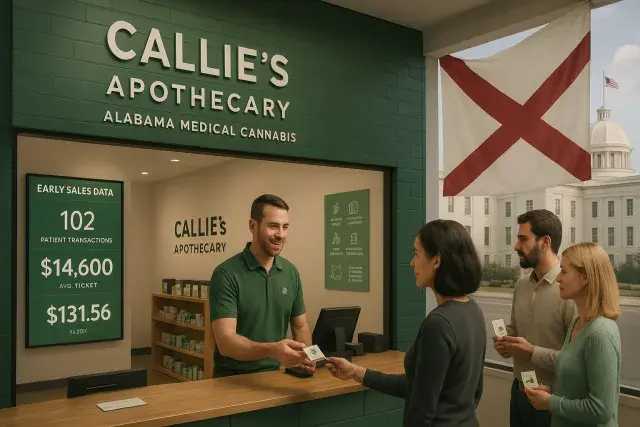
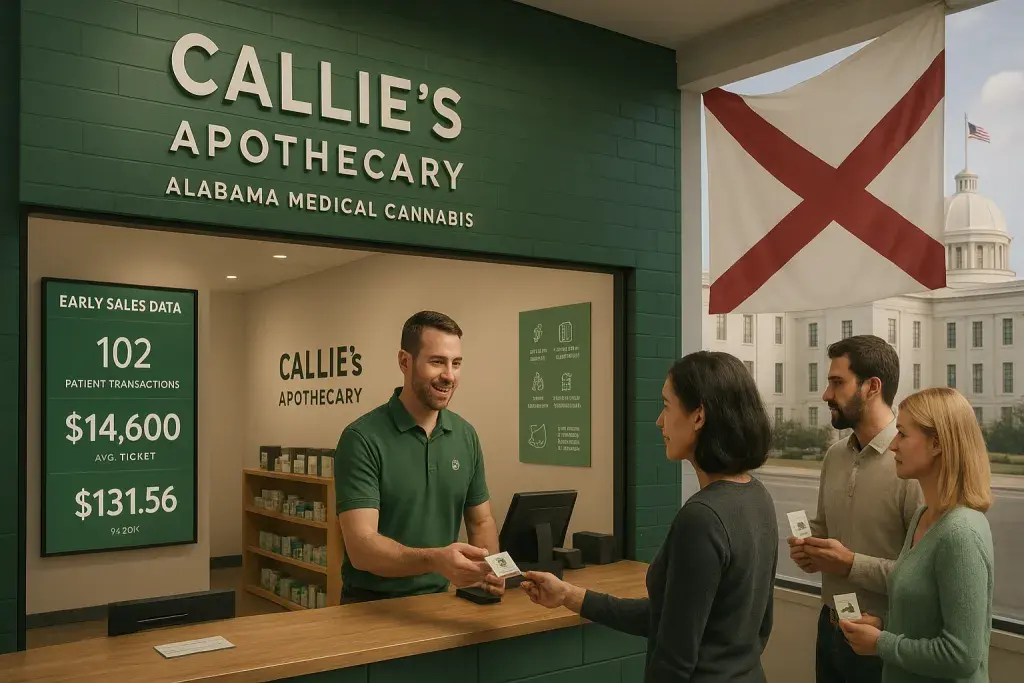
Alabama's medical cannabis program recorded its first 102 patient transactions in roughly a week of retail operations, generating approximately $14,600 in pre-tax sales at an average ticket of $131.56 - modest numbers by any mature market standard, but a legitimate commercial start for a program that has spent years mired in litigation and licensing delays. Callie's Apothecary, operating out of Montgomery, became the state's first legal medical cannabis dispensary when it opened June 4, and the Alabama Medical Cannabis Commission confirmed the transaction data Thursday.
The numbers are small, but that's expected in a market this tightly constrained. Alabama's approved product forms are limited to tablets, tinctures, patches, oils, and gel cubes - no raw plant material, no smokable flower. The patient pool is still thin: 446 cards issued out of 481 applications filed, and only 21 physicians have actually made cannabis recommendations despite 52 being certified and 39 registered with the AMCC. For operators considering infrastructure investment - POS configuration, inventory protocols, compliance logging - the Alabama build-out looks structurally similar to early-stage rollouts in other restricted medical states, a category where even mature cannabis pos software oregon deployments had to be adapted significantly when operators expanded into medical-only states with narrower product menus and stricter dispensing limits. Compliance architecture matters early; retrofitting it later is expensive.
What's striking here is how openly the dispensary owner described supply rationing in the first days of operation. Vince Schilleci, Callie's owner, confirmed that the store limited how much each patient could purchase before supplies stabilized - not a compliance action, but a straightforward inventory management decision driven by constrained product batches and uncertain delivery timing. That kind of rationing creates real friction in the patient experience and, from a retail operations standpoint, complicates both transaction planning and seed-to-sale reconciliation. The dispensary received a second product shipment Thursday and expected a third on Friday. Per-product pricing runs $42 to $52, and patients may purchase up to a 60-day allotment - a ceiling defined by state law, not store policy.
A Licensing Bottleneck Still Limits Geographic Reach
One dispensary serving all of Alabama is not a distribution system. It is a proof of concept. Three additional licensed dispensary companies - CCS of Alabama, GP6 Wellness, and RJK Holdings - are expected to open storefronts this summer, which would begin to address the geographic access problem. A fourth license remains tied up in litigation but is expected to go to Yellowhammer Medical Dispensaries. Until those locations open, patients outside driving range of Montgomery have no practical access to the products their physicians have recommended.
That gap matters for more than patient convenience. Physician participation tends to track with perceived patient access - providers are less inclined to recommend a therapy their patients cannot reasonably obtain. With only 21 of 52 certified physicians having made any recommendations, the program is operating well below its registered clinical capacity. As dispensaries expand geographically, physician engagement will be the metric worth watching, because physician recommendations are the upstream variable that drives patient card applications, which drive dispensary foot traffic and, eventually, commercially viable transaction volumes.
The Business Case Is Long, Not Immediate
To put it plainly: $14,600 in pre-tax sales across 111 transactions is not a financial event. It is an operational confirmation that the supply chain can move product from licensed processor to licensed dispensary to registered patient - compliantly, with documentation, and without the litigation-driven interruptions that have defined this program since the 2021 enabling legislation passed. That is not nothing. Programs that reach commercial viability in medical cannabis typically do so through slow accumulation: more physicians certifying, more patients registering, more dispensary locations opening, and product SKU variety expanding as processors move through lab testing and approval cycles.
The AMCC noted Thursday that work continues with processors on new products to expand inventory variety. That matters for dispensary economics. A narrow product menu constrains average transaction value and limits repeat-visit incentives. As processors bring additional compliant SKUs through testing and into the wholesale supply chain, dispensary operators will need their inventory management systems and compliance logs configured to handle batch documentation, shelf-life tracking, and accurate point-of-sale attribution across a growing product set - standard practice in more developed state markets, but infrastructure that needs to be in place before volume scales, not after.
What Operators Watching Alabama Should Take Away
For dispensary operators, investors, and suppliers tracking Alabama as a potential market, the early data points to a few practical realities. The patient population is self-selected - these are motivated registrants who navigated a new state system and found a single location to purchase from. Average transaction values around $131 reflect both the legal purchase limits and current product pricing, not necessarily patient demand depth. As access points multiply and the physician recommendation pipeline matures, transaction volumes should rise; whether margins hold will depend heavily on wholesale pricing from processors and the state's tax treatment of medical cannabis sales.
The litigation history also deserves attention from anyone underwriting a cannabis retail build-out here. Licensing disputes delayed three of four dispensary licenses until December, compressing the runway for operators who committed capital well before they could open doors. That is a structural risk in any limited-license medical state, and Alabama's experience is not unique - but it is a useful reminder that licensing timelines in regulated cannabis markets routinely overrun projections, and capital planning should reflect that reality. Schilleci said it plainly: he would do it again. The business case, in his telling, rests as much on patient outcomes as on the balance sheet. That is a fair position for a first mover to take. Later entrants will be held to a stricter financial standard.