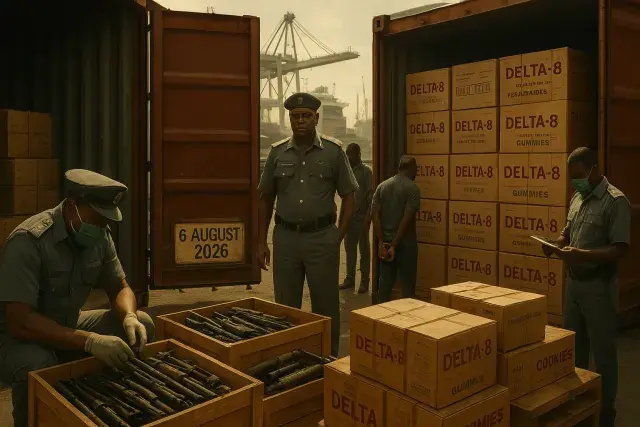
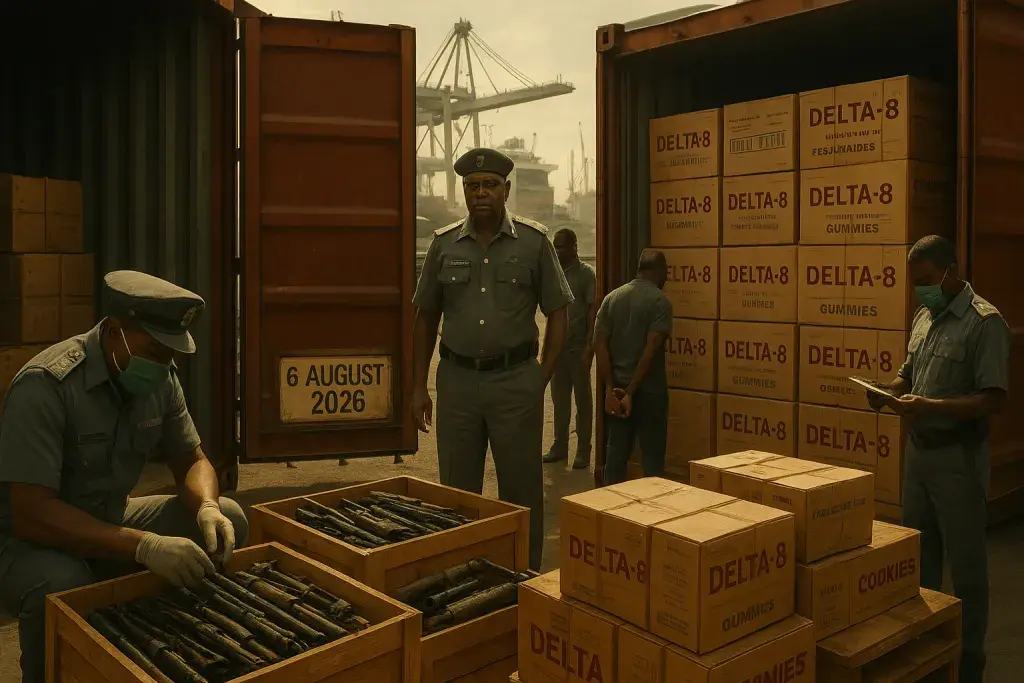
A single flagged container at Tincan Island Port has exposed two distinct smuggling operations running through Nigeria's legitimate trade channels - one involving knocked-down rifle components, the other involving cannabis-infused consumer products worth hundreds of millions of naira. The Nigeria Customs Service (NCS) announced the seizures on Thursday, 6 August 2026, framing them as evidence of a broader enforcement push ahead of the country's next election cycle. For an agency tasked with policing both weapons trafficking and narcotics diversion through the same ports, the case illustrates how thin the line has become between routine cargo inspection and national security work.
The weapons portion of the case began with a container that arrived aboard MV VELIKA on 8 July 2026, flagged by the Service's intelligence-driven risk management system before officers ever opened it. That detail matters more than it might seem. Modern customs enforcement, in Nigeria as in most trade-heavy jurisdictions, now runs on layered risk profiling - manifest data, shipping history, point-of-origin patterns - long before a physical exam takes place. Inside, officers found crates of knocked-down components preliminarily identified as JoJeff pump-action rifles, more than 140 sets, concealed among what likely presented as ordinary trade goods. Two suspects are in custody; a third remains at large. It's the kind of case that, in a regulated consumer goods context, would draw comparisons to how licensed operators track inventory through seed-to-sale systems like those built into Metrc-compliant POS for Illinois retailers - traceability as the default expectation, not an afterthought bolted on after something goes wrong.
Cannabis Products Concealed Among Used Goods
In a separate operation, officers intercepted two 40-foot containers carrying cannabis-infused cookies, gummies and pre-roll products hidden alongside used vehicles, generators, batteries and other imported merchandise. Customs itemized the haul precisely: 109 cartons of Delta-8 cannabis-infused pre-roll cookies, 125 cartons of Delta-8 gummies, and 73 cartons of cannabis-infused cookies, with a combined street value placed at ₦373,802,640. That level of specificity - cartons counted, SKUs distinguished by product type - reflects standard customs documentation practice, but it also underscores a compliance reality that licensed cannabis markets elsewhere grapple with daily: infused edibles are compact, shelf-stable, and easy to disguise inside unrelated freight. Nigeria has no legal adult-use or medical retail framework comparable to U.S. state markets, so any cannabis-infused product entering the country arrives outside any lab-testing, labeling, or COA regime. There's no batch verification, no dosage disclosure, no regulated packaging standard behind these goods - which is precisely why customs treats them as contraband rather than commerce.
Election-Season Enforcement and the Insider Risk
Comptroller General Adewale Adeniyi was direct about timing. Nigeria is heading into a major election cycle, and he expects criminal networks to test border, port, and airport controls more aggressively during that window. That's not a new pattern in trade enforcement generally - political transitions tend to draw increased smuggling activity, whether the contraband is weapons, cash, or restricted goods. What's notable here is Adeniyi's explicit warning about internal compromise, stating the Service "will not harbour any of these people who want to serve as accomplices." For a customs operation, insider risk is arguably harder to manage than external smuggling attempts; it requires internal audit discipline layered on top of the same risk-profiling tools used against outside actors.
What the Case Signals for Trade Oversight
Fair enough, one seizure doesn't prove a trend. But the dual nature of this case - weapons parts and infused cannabis products moving through the same enforcement pipeline within weeks of each other - points to how smuggling networks diversify cargo to spread risk across multiple commodity types. For legitimate importers and freight forwarders operating through Tincan Island, the practical implication is straightforward: expect longer dwell times, more physical exams, and tighter documentation scrutiny as the Service leans harder on its risk-management systems through the election period.
- Container flagged via intelligence-driven risk profiling before physical inspection
- 140-plus pump-action rifle component sets seized; two suspects arrested, one at large
- 307 total cartons of Delta-8 and cannabis-infused edibles intercepted across two containers
- Combined cannabis product value estimated at ₦373,802,640
- Heightened scrutiny expected across Nigerian ports through the upcoming election cycle