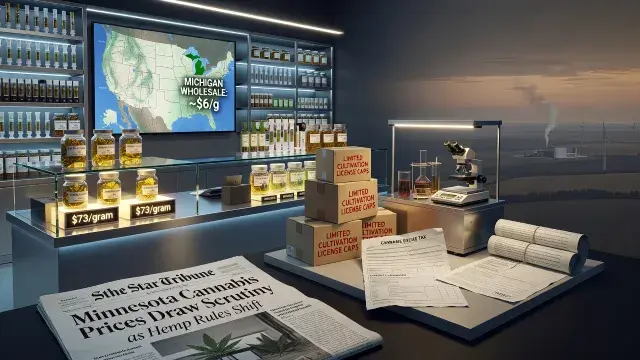
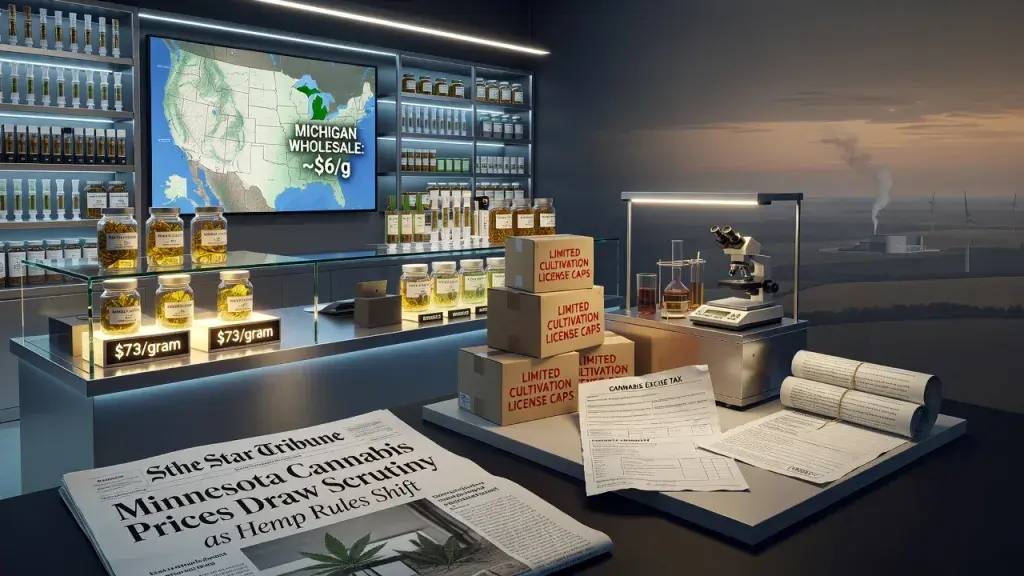
A $73 gram of distillate in Minnesota versus roughly $6 in Michigan is the kind of gap that stops a spreadsheet exercise and turns it into a policy argument. That comparison, raised recently by the Star Tribune editorial board, has reignited debate over whether Minnesota's adult-use market is still finding its footing or structurally mispriced. Two years into legal sales, the state's cannabis sector is also staring down a federal hemp rule change and, this weekend, a far lower-stakes agricultural event that has nothing to do with intoxication at all.
Why Minnesota's Wholesale Pricing Looks So Out of Step
A tenfold price differential between neighboring states does not happen by accident. It reflects supply constraints, limited cultivation capacity, and a licensing structure still ramping toward maturity. In mature markets like Michigan, oversupply has pushed wholesale pricing down to levels that squeeze cultivators but reward consumers. Minnesota, by contrast, is earlier in its build-out, with fewer licensed cultivators feeding dispensary shelves and less competitive pressure on distillate and concentrate pricing specifically. The Star Tribune's position was not that Minnesota should walk back legalization; it was that regulators need to address the mechanisms, license caps, cultivation bottlenecks, testing costs, tax structure, that keep prices elevated. For operators, this matters beyond headlines. High wholesale costs compress margins at the dispensary counter, complicate SKU management, and make it harder to compete with the illicit market, which doesn't file compliance logs or pay excise tax.
The December 11 Hemp Rule: What Actually Changes
In 70 days, the federal definition governing hemp shifts from delta-9 THC content to total THC, a technical change with real consequences for anyone manufacturing or distributing hemp-derived products across state lines. For Minnesota shoppers, the practical effect is minimal: products legal to buy today remain legal to buy under current state law. The real pressure lands on the business side. Total THC calculations can reclassify products that previously qualified as hemp, triggering new compliance obligations around lab testing, COA documentation, and interstate shipping manifests. Banking relationships, already fragile under 280E and federal scheduling, add another layer of uncertainty. Payment processors and accountants serving hemp-adjacent businesses are the ones who need to be paying attention this fall, not the end consumer standing at a dispensary counter.
A Reminder That Hemp Is Also an Agricultural Product
Not every hemp story is about THC math. Willow's Keep Farm in Zumbrota is running a daytime hemp maze this weekend, Saturday and Sunday, noon to 5 p.m., with a $10 admission covering the maze and disc golf. The plants grown for the maze are not cultivated for intoxicating effect, and the event is a useful reminder that hemp occupies agricultural and recreational spaces well outside the regulated cannabinoid market. For an industry often discussed only in terms of licensing and tax policy, it's a small but clarifying data point: hemp's footprint in Minnesota is broader than the retail shelf.
What Operators Should Be Watching
- Wholesale pricing trends and whether cultivation license issuance narrows the Minnesota-Michigan gap over time
- Total THC compliance documentation ahead of the December 11 federal shift
- Banking and payment processor communications regarding interstate hemp shipments
- Accountant guidance on 280E exposure as product classifications shift
None of this changes what's legal on a Minnesota dispensary shelf today. But the back office, compliance logs, tax filings, wholesale contracts, is where the next few months will actually get decided.