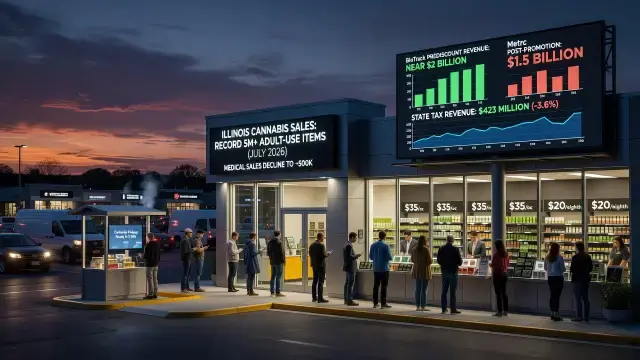
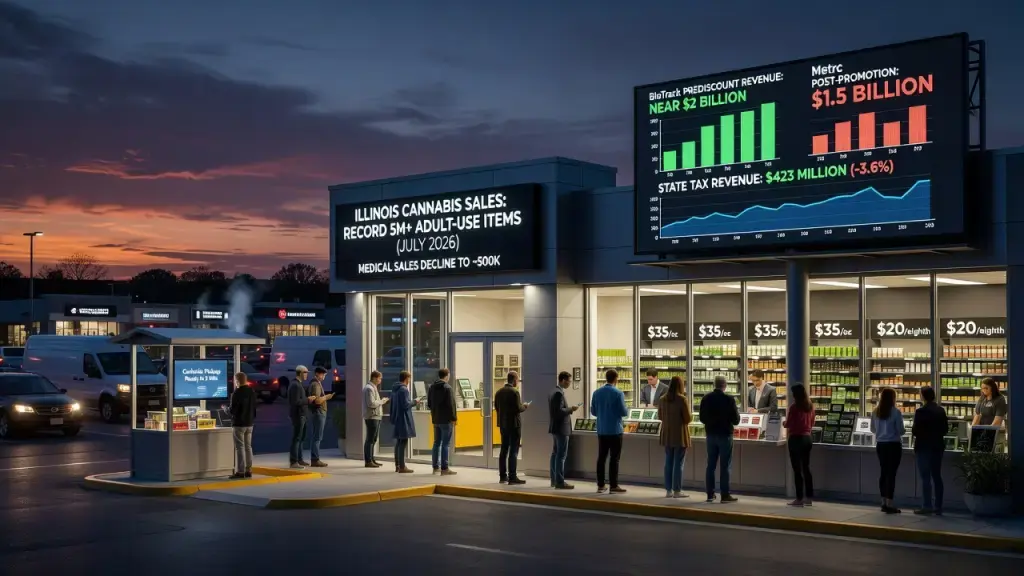
Illinois shoppers bought more cannabis than ever in fiscal year 2026, but the businesses selling it to them are keeping less of each transaction. The state's new annual cannabis report shows reported retail sales fell to about $1.5 billion, down from nearly $2 billion the prior year, even as unit sales kept climbing and store counts expanded. The gap between rising demand and shrinking revenue is the story operators need to understand heading into next year.
A Reporting Shift Muddies the Picture, But Not Entirely
Part of that steep drop traces back to a technical change rather than a collapse in consumer spending. Illinois swapped its old BioTrack seed-to-sale tracking system for Metrc, and the two platforms count revenue differently. BioTrack recorded prediscount prices; Metrc captures what customers actually paid after promotions and markdowns. Kimber Beckler, spokesperson for the Illinois Department of Financial and Professional Regulation, called it an "apples to oranges comparison" - a fair description, given how differently the two systems handle budroom discounting. State cannabis retail tax revenue, a steadier measure since it's calculated consistently year to year, declined by a far more modest 3.6%, landing at $423 million. That's the number operators should weight more heavily than the headline sales figure. And when regulators compared July and August under Metrc for both years - an apples-to-apples window - sales were actually up 10% and 6.6%, respectively. In practice, the market isn't shrinking so much as it's being measured more honestly.
More Stores, More Access, Lower Prices
The state added 29 dispensary licenses this fiscal year, pushing the store count up roughly 10%. A new law also let every licensed dispensary sell medical cannabis, authorized drive-thru windows and curbside pickup, and doubled the possession limit for buyers. More locations and easier access mean more items sold - adult-use item counts topped 5 million in July alone, while medical item counts kept sliding toward half a million. But wider distribution plus a growing supply of compliant product is doing exactly what basic retail economics predicts: compressing prices. "Overall, you're seeing price compression," said Scott Redman, founder of the Illinois Independent Craft Growers Association. "More dispensaries, unless they're in locations that are underserved. It just divides the pie into more pieces." A pending rule change allowing outdoor and greenhouse cultivation for edibles and infused products could push wholesale costs down further, since outdoor grows use far less energy than indoor cultivation. Cheaper inputs tend to show up on the shelf eventually.
Competitive Pressure From Hemp and Neighboring States
Licensed dispensaries aren't only competing with each other. Unlicensed intoxicating hemp products, sold with minimal oversight in gas stations, convenience stores and smoke shops, have pulled customers away from the regulated, lab-tested, compliant-packaging channel. Those products are set to be banned in Illinois this November and nationwide in December, a restriction licensed operators have pushed for. Illinois has also bled out-of-state customers to lower-tax, higher-supply markets in Michigan and Missouri - though that reversed somewhat after Michigan added a 24% wholesale tax on recreational cannabis this year, on top of its existing 10% retail tax. For an industry still operating under Section 280E's federal tax burden, every point of price compression or tax shift lands directly on thin operating margins.
Consolidation, Equity Licensing, and Enforcement
The number of new retail licenses issued fell sharply, from 93 the prior year to just 29, as financing for new stores dried up. Meanwhile, license transfers kept climbing - from 21 to 36 to 50 - a clear signal of consolidation as larger multistate operators absorb independent stores that can't keep up. The state reported 177 social equity licenses, with 38 dispensaries majority-owned by women and 103 by people of color, though none majority-owned by people with disabilities. Ownership identities largely remain shielded by state confidentiality rules, though regulators say they plan unspecified steps toward greater transparency this year. Illicit trafficking hasn't disappeared either: state police seized more than 47,000 pounds of illegal cannabis over the past two fiscal years, with Chicago serving as a Midwest distribution hub fed by oversupply from Michigan, California and Oregon. For licensed retailers investing in compliance logs, COAs, and point-of-sale accuracy, that illicit shadow market remains a persistent drag on legitimate pricing power.