A federal law set to take effect December 11 could force the vast majority of hemp-derived CBD products off the market, reshaping an industry that grew from a regulatory gray zone into an estimated $28 billion business. For Vermont companies like Sunsoil, the Hardwick manufacturer cofounded by Alejandro Bergad and Jacob Goldstein in 2015, the deadline forces a choice: reformulate now, or wait and hope Congress intervenes again.
How a Drafting Gap Became a Market
The 2018 Farm Bill legalized hemp - defined as cannabis containing 0.3 percent or less delta-9 THC - opening the door to CBD oils, tinctures, salves and supplements. What lawmakers didn't anticipate was that hemp also contains other psychoactive compounds, namely delta-8 and delta-10 THC, that fell outside the statute's language. That omission let manufacturers sell intoxicating products under the hemp label, with little testing, no potency caps, and minimal oversight. Gas stations and convenience stores became unlikely retail channels for products that would be illegal inside a licensed dispensary.
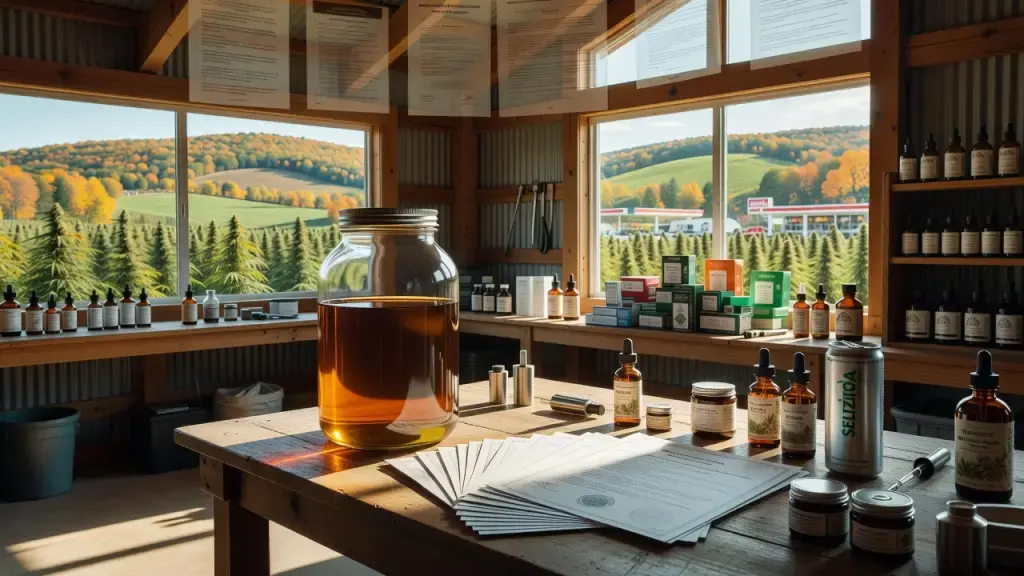
James Pepper, who chairs the Vermont Cannabis Control Board, put it bluntly: the market exploded with "highly intoxicating, unregulated THC products" posing as hemp. A can of seltzer manufactured in Florida and sitting on his desk contains five times Vermont's legal THC limit for beverages - sold, in theory, to anyone with a mailbox.
The Fix That Broke Compliant Products
Congress rewrote the federal hemp definition last year, capping total THC at 0.4 milligrams per container rather than per serving. That sounds like a tidy fix for the gas-station seltzer problem. In practice, though, it also snares nonintoxicating CBD supplements that test well under 0.3 percent THC per serving but exceed the new limit once you add up the THC across an entire bottle. Industry estimates suggest roughly 95 percent of current hemp-derived products would become noncompliant under this standard - not because they're intoxicating, but because of how the math works at the container level.
That's the operational bind facing Vermont's hemp processors. They're regulated federally by the USDA, not the state, and most sell the bulk of their volume across state lines - meaning a shift in federal law hits their entire customer base at once, not just a regional market.
What Operators Are Actually Doing
Responses vary. Some Vermont producers are betting Congress delays the effective date again, as it has before, and are holding their current formulations. Others are reformulating to strip THC entirely, accepting a different product profile to stay inside the new limit. Sunset Lake Farms in South Hero illustrates the complexity: its CBD supplement business operates as a separate legal entity from its licensed cannabis company, Sunset Lake Cannabis, even though the two share a name and a building. CBD accounts for roughly 30 percent of their combined revenue, sold into 49 states and several territories - a reach the cannabis side can't match, since state-licensed cannabis still can't cross state lines.
For compliance teams, the practical questions are immediate: Which SKUs need reformulation? What does a new certificate of analysis look like under a per-container THC standard? And how much inventory currently on wholesale menus becomes unsellable overnight if the deadline holds?
Why Regulators Are Watching Closely
Bergad's assessment - that "greed" from bad actors exploiting the delta-8 loophole invited the crackdown - reflects a pattern familiar across regulated retail: under-enforcement of a gray-market segment eventually produces blunt federal correction that punishes compliant operators alongside bad ones. Vermont's cannabis board has had authority since 2022 to treat any cannabinoid concentrate above 0.3 percent THC as cannabis requiring a state license, yet mail-order sales have remained largely outside its enforcement reach. That gap between state authority and federal mail-order commerce is exactly what the new law aims to close - and exactly what's now threatening compliant CBD brands that never sold intoxicating products in the first place.