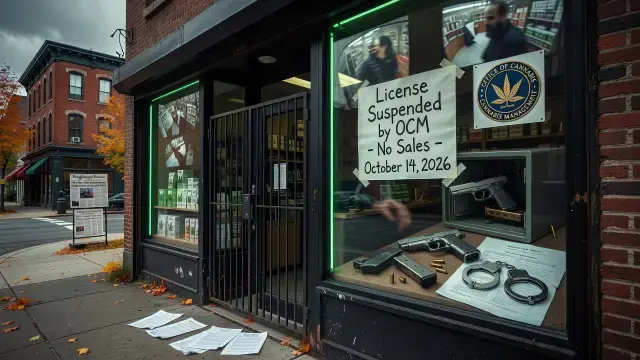
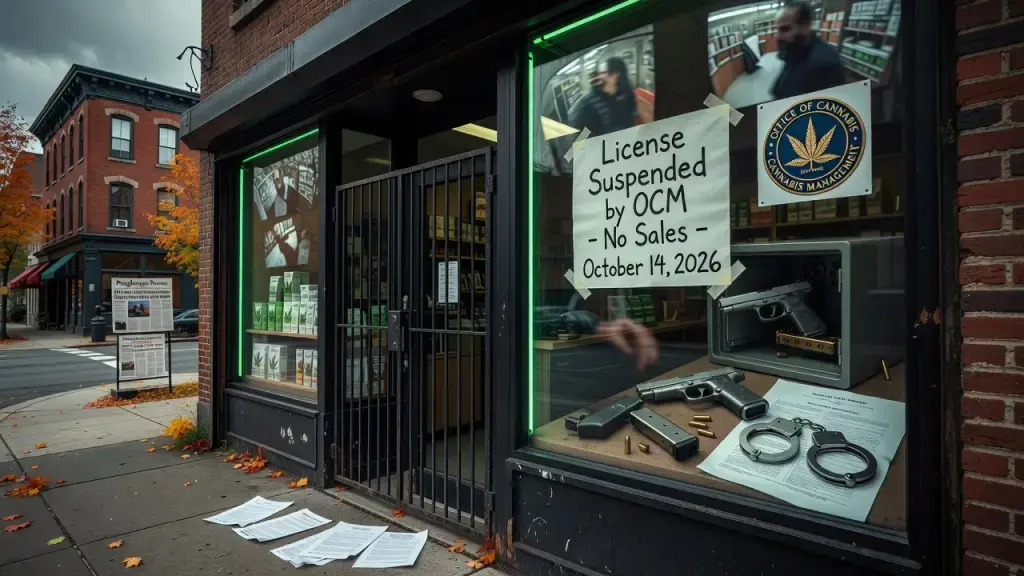
A handwritten-sounding sign on a locked door turns out to be the least of it. New York's Office of Cannabis Management suspended the license of Black Market Canna Co. on October 14, 2026, cutting off sales at Dutchess County's first licensed adult-use dispensary while its owner sits in federal custody facing a firearms charge - and, according to court filings, something far more serious.
A Suspension, Not Yet a Closure
Here's the distinction operators should sit with: OCM's order stops cannabis sales immediately, but it did not include a seal on the premises at 89 Main Street in Poughkeepsie. That's a meaningful regulatory line. A suspension pauses retail activity pending review; a sealed building signals the state considers the location itself a continuing hazard. For now, Black Market Canna Co. occupies the first category - frozen, but not necessarily finished. Whether that status holds depends on how OCM weighs the underlying conduct against the license itself, a process that can run on a timeline separate from the criminal case.
For other licensees, the lesson is blunt. OCM's enforcement authority isn't limited to packaging violations or seed-to-sale tracking discrepancies in METRC. Public safety findings tied to an owner's personal conduct - even conduct occurring away from the budroom - can trigger a suspension that halts revenue overnight, with no advance notice beyond a posted order and an 11 a.m. visit from the agency.
Firearms, a Felony Record, and a Business Built on Compliance
The federal complaint against Ali Khan Lodhi alleges investigators recovered two 9mm handguns, loaded magazines and hundreds of rounds of ammunition during a July 29 search of his home and vehicle - one weapon reportedly found near a gun safe in the garage, another magnetically mounted to a workbench. Prosecutors say Lodhi, barred from possessing firearms due to prior felony convictions, told investigators the guns belonged to his domestic partner. She allegedly said she'd given them to him for safekeeping.
What's striking here is the surveillance detail: prosecutors cite dispensary footage from March 2026 that appears to show Lodhi handing a handgun to another person inside the business. If accurate, that places an alleged firearm inside a state-licensed cannabis retail environment - a setting where OCM rules already demand strict security protocols, limited access points and surveillance retention precisely to prevent this kind of incident. A licensed dispensary is not a casual retail space in the eyes of regulators; it's treated closer to a cash-intensive, security-sensitive operation, similar in spirit to how banks or jewelers are regulated, given the federal illegality of cannabis still complicates routine banking and cashless payment options for the industry.
Allegations Escalate Well Beyond a Licensing Dispute
The firearms charge alone would be enough to unsettle a dispensary's standing. But federal prosecutors have gone further, alleging in court filings reported by the Poughkeepsie Journal that Lodhi attempted to arrange the killing of his business partner - a person he was separately engaged in litigation with. Prosecutors say he approached two individuals in separate attempts, one allegedly asked to carry out the act directly, another allegedly a Black Market Canna Co. employee asked to find someone willing to do it. Neither alleged plot advanced, according to reporting. A federal judge denied Lodhi's bail request on October 14, citing these allegations, and he remains detained pending trial.
None of this is proven in court. Lodhi is presumed innocent on the firearms charge, and the murder-for-hire allegations remain arguments made during bail proceedings rather than formal charges adjudicated at trial. Still, for a business partner, a landlord, a payment processor, or a compliance vendor connected to the dispensary, the practical exposure doesn't wait for a verdict. Ownership disputes involving licensed cannabis businesses already carry outsized stakes - control of a limited license, inventory, wholesale relationships, and often personal guarantees on leases or loans. When a dispute escalates into alleged violence, it becomes a case study in why social equity licensing frameworks and background-check provisions exist in the first place, even when they inevitably miss things.
What Operators Should Take From This
- OCM can suspend sales based on public safety findings independent of any criminal conviction, and it can act fast once it decides to.
- A suspension order without a building seal leaves room for reinstatement, but that outcome is not automatic or guaranteed.
- Security protocols inside licensed retail spaces, including surveillance footage retention, can become evidence in matters entirely unrelated to compliance checks.
- Ownership and partnership disputes in cannabis retail carry legal and reputational risk that extends well past the license itself.
The dispensary's future now runs on two separate tracks - a federal criminal case that will take months to resolve, and a state licensing review with its own pace and standards. Until OCM issues a further determination, the sign on the door stands as the clearest public signal available.