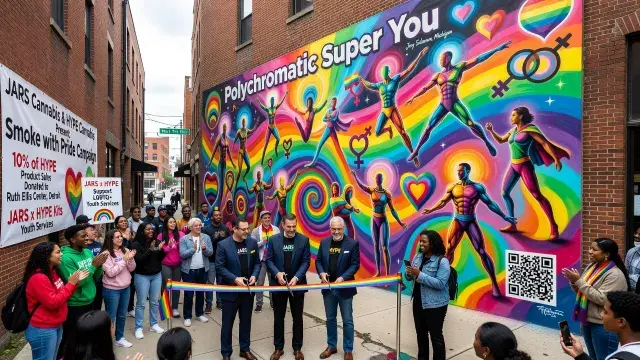
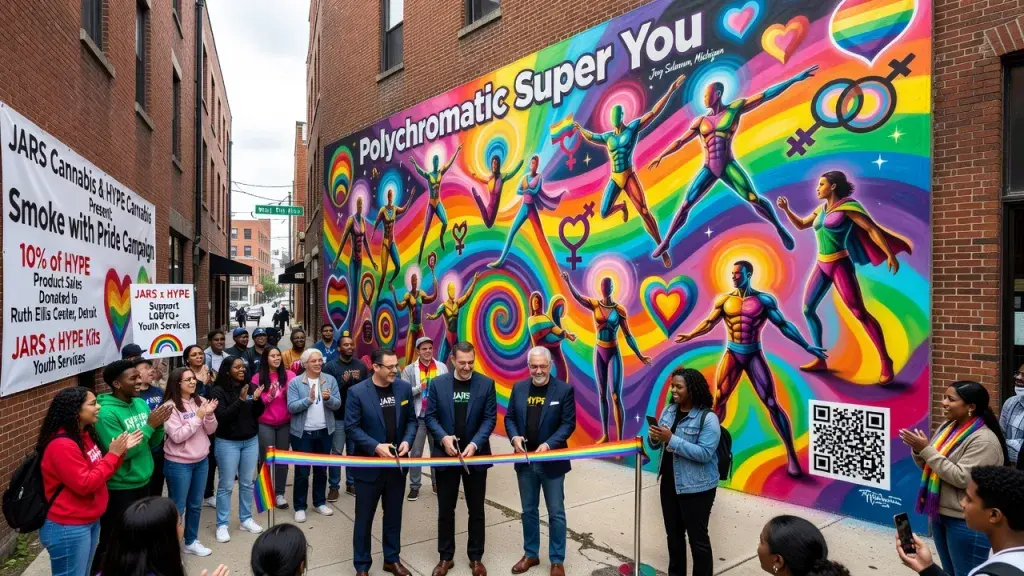
Two Michigan cannabis retailers cut the ribbon this week on a 40-by-25-foot mural in downtown Ferndale, marking a rare instance of dispensary marketing dollars flowing directly into a public art commission with a stated charitable purpose. "Polychromatic Super You," painted by Michigan-based artist Joey Salamon in an alley off West Nine Mile Road, was commissioned by JARS Cannabis and HYPE Cannabis as the visual centerpiece of their joint Smoke with Pride campaign, which benefits Detroit's Ruth Ellis Center.
The retail mechanics behind the mural matter as much as the artwork itself. Under the campaign, 10 percent of proceeds from HYPE products sold at JARS locations, and 100 percent of proceeds from a dedicated JARS x HYPE Smoke with Pride Kit, are earmarked for donation. That kind of point-of-sale-linked giving requires clean SKU management and accurate transaction tracking to actually deliver on the pledge - a retailer can't reliably route a percentage of category sales to a nonprofit without a back-end system built to isolate those line items. It's a reminder that even a feel-good cause marketing push rides on the same infrastructure operators use for tax reporting and inventory reconciliation, whether that's a standard cannabis POS setup or a system built for a specific regulatory environment, such as a marijuana point of sale system virginia dispensaries might use to separate promotional SKUs from standard wholesale pricing tiers. marijuana point of sale system virginia
Cause Marketing Meets Compliance Reality
Dispensaries operate in a marketing environment far more restricted than most consumer retail categories. Advertising rules in Michigan, as in most adult-use states, limit how cannabis products can be promoted, where signage can appear, and how closely brand messaging can be tied to consumption. A mural sidesteps a lot of that friction - it's public art, not a product ad, and the QR code embedded in the piece routes visitors to donation and resource information rather than a menu or a storefront. That distinction is not incidental. It's the kind of structure a compliance team would recognize as a way to build brand visibility and community goodwill without tripping the advertising restrictions that govern direct cannabis promotion.
Why Community Investment Carries Weight for Operators
For multi-state operators and single-location dispensaries alike, community-facing investment has become a practical necessity, not just goodwill. Local zoning boards, city councils, and neighborhood associations often hold real influence over license renewals, signage permits, and expansion approvals. A retailer with a visible, well-documented record of local giving has a different conversation with a planning commission than one with none. JARS Marketing Director Stefanie Michels framed the mural as an effort to connect cannabis retail's counterculture roots to LGBTQ+ history, but the underlying business logic is straightforward: public art tied to a documented donation structure builds civic standing in a way a coupon campaign never could.
What This Signals for Retail Strategy
The Ruth Ellis Center partnership also reflects a broader shift among cannabis operators toward transparent, trackable philanthropy rather than vague "give back" messaging. Consumers and regulators alike have grown skeptical of unverified charitable claims across retail generally, and cannabis brands face extra scrutiny given the industry's federal illegality and its 280E tax burden, which already limits standard deductions available to ordinary retailers. Publicizing a fixed percentage tied to specific SKUs, and backing it with a QR-code paper trail, gives the campaign a level of accountability that plain-language ad copy doesn't. For other operators weighing similar campaigns, the lesson is less about the mural and more about the systems required to make a giving pledge verifiable - accurate point-of-sale segmentation, clear reporting, and a public-facing mechanism for customers to confirm where the money actually goes.