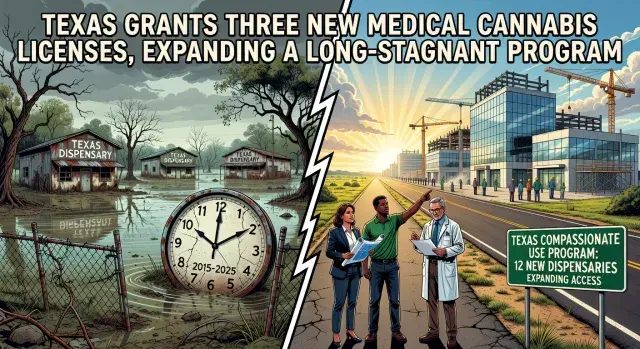
For a decade, exactly three dispensaries served every medical cannabis patient in Texas. That number is finally changing. On April 1, the Texas Department of Public Safety issued conditional licenses to three additional medical cannabis companies-part of a broader push to bring 12 new dispensaries into the state's Compassionate Use Program, which has long been criticized as too restrictive to meaningfully serve patients.
A Decade of Three Dispensaries
Texas launched its Compassionate Use Program in 2015, and for years it remained one of the most limited medical cannabis frameworks in the country. Only three dispensaries-Texas Original, Goodblend, and Fluent-held licenses to cultivate, process, and sell low-THC cannabis products statewide. The list of qualifying conditions was narrow. The types of products physicians could prescribe were narrower still. Advocacy groups pushed hard during the 2025 legislative session, arguing that the program's constraints created real barriers: patients couldn't access medications quickly, costs ran high, and physicians lacked the prescribing flexibility they needed.
Lawmakers responded with House Bill 46. The legislation did three significant things. It expanded qualifying conditions to include chronic pain, Crohn's disease, and terminal illnesses-joining existing conditions like epilepsy, cancer, and PTSD. It authorized new product formats, including inhalers and vaping devices. And it directed the DPS to license a dozen more dispensaries. That last part is where the April 1 announcement fits in.
Who Got the Licenses-and What Comes Next
The three newly approved companies are GTI Texas, LLC (operating as RISE Dispensaries) in West Texas; Cresco Labs Texas, LLC in East Texas; and Texas Medica Collective, LLC in Northeast Texas. Two of these are subsidiaries of large multistate operators headquartered in Chicago. RISE runs 97 locations across 14 states; Cresco operates 71 dispensaries in eight. Texas Medica Collective, by contrast, does not appear to have operations elsewhere.
Here's the catch: a conditional license is not a green light. The DPS made that explicit, stating in its release that the announcement "does not guarantee that these businesses will be issued final TCUP licenses." Each company must survive a due diligence evaluation covering finances, litigation history, and past disciplinary actions. The nine companies that received conditional licenses back in December still haven't appeared on the DPS's active dispensary list. Businesses have 24 months from licensure to become fully operational-but first, they have to clear the state's vetting process.
An additional 12 companies were placed on a "license eligibility list," essentially a bench of alternates. If any conditional licensee fails evaluation or violates requirements, the DPS will look to that list for replacements.
Satellite Locations and the Access Problem
One of the quieter but potentially more consequential provisions of HB 46 allows dispensaries to establish satellite locations-sites where medical cannabis products can be stored overnight, closer to patients. The logic is straightforward: if a patient in Lubbock orders medication, it shouldn't have to ship from Austin. Texas Original has already opened satellites in San Antonio, Plano, Nacogdoches, Lubbock, and Tyler. Advocates say this model could "dramatically reduce" costs and same-day wait times. For a state as geographically vast as Texas, distribution logistics aren't a footnote-they're the whole story for patients in rural areas.
Meanwhile, the Hemp Industry Faces a Squeeze
The expansion of medical cannabis is happening alongside a sharp contraction in the consumable hemp market. New state regulations took effect March 31, raising fees for hemp businesses by more than 3,000% and-more critically-changing how THC content is measured. Previously, Texas classified products as legal hemp if they contained 0.3% or less Delta-9 THC by dry weight. The new rules require measurement of total THC, including THCA, a naturally occurring cannabinoid that converts to THC when heated.
Industry figures have warned that this reclassification effectively outlaws most smokable hemp flower products, which tend to contain higher levels of THCA than processed edibles or beverages. Roughly half the consumable hemp products sold by Texas's estimated 9,000 retailers reportedly contain smokable flower. Hemp beverages, edibles, and tinctures remain legal, provided they meet revised THC limits and new compliance requirements. But for a multibillion-dollar industry, losing half its product line is not a minor adjustment.
The simultaneous loosening of medical cannabis rules and tightening of hemp regulations tells a clear story about where Texas regulators want cannabis commerce to go: into tightly licensed, physician-supervised channels, not corner-store shelves. Whether that framework actually serves patients better-or just consolidates market power among a handful of well-capitalized operators-remains an open question.