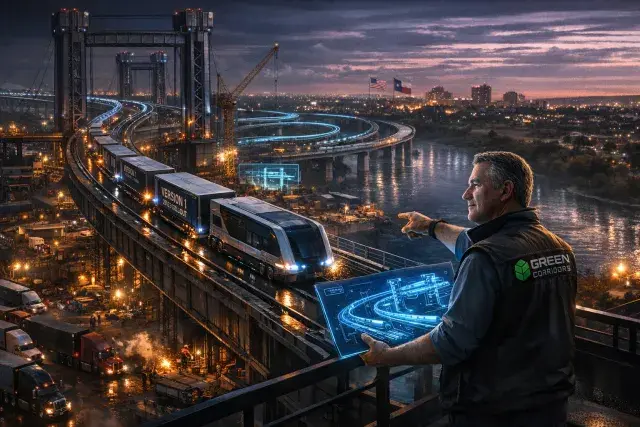
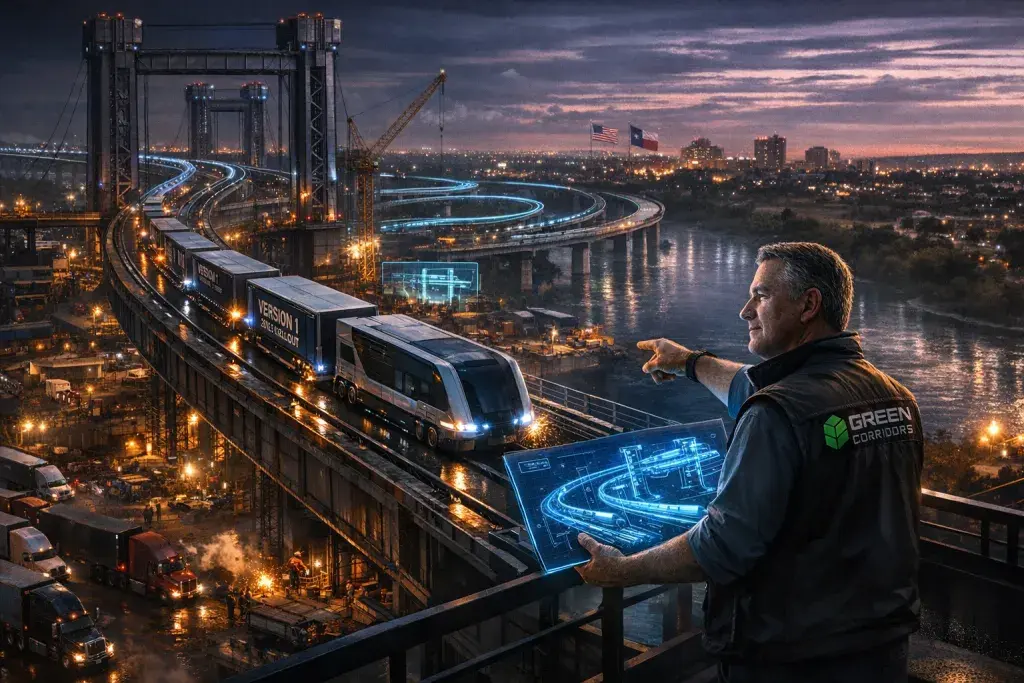
Houston-based Green Corridors is gearing up to build prototypes for its ambitious "Project Pegasi," an elevated freight guideway and bridge across the Rio Grande at the U.S.-Mexico border in Laredo, Texas. With presidential approval secured in June, construction of shuttle, lift, and guideway prototypes begins within six months, promising to transform the busiest U.S. truck crossing by easing congestion, cutting emissions, and slashing fraud.
Project Details and Development Timeline
Project Pegasi features automated diesel-hybrid steel shuttles operating in platoons on a dedicated guideway, likened to a conveyor belt for steady, reliable freight movement. CEO Mitch Carlson, in an exclusive interview, revealed that digital twin modeling has refined designs over three years, reaching NASA Technology Readiness Level 4 and targeting Level 7 soon. Prototypes will be manufactured in Texas or Nuevo Leon, Mexico, with a 2-mile test track featuring an S-curve ready by August or September 2026.
- Shuttles designed digitally, including welding procedures, for Version 1 rollout in 2026.
- Full operation envisions 2,500 shuttles transporting containers from Monterrey to Laredo in four to five hours.
- Estimated cost: $6-10 billion, funded via debt, equity, and infrastructure investors.
Key Benefits for Trade and Security
Laredo handles massive truck volumes as one of four key Texas-Mexico crossings, alongside Brownsville, Eagle Pass, and El Paso, but nighttime closures and wait times plague efficiency. Pegasi addresses this with 24/7 operations, pre-U.S. scanning in Mexico for predictable logistics, and tamper-proof loading to curb theft and fraud—critical amid rising nearshoring trends boosting North American supply chains.
- Keeps U.S. drivers north of the border, sidestepping visa issues.
- Reduces emissions through efficient platooning versus idling trucks.
- Provides CBP inspection facilities at no public cost, per presidential permit.
Implications for U.S.-Mexico Trade and Sustainability
This initiative taps into surging bilateral trade, projected to grow with manufacturing shifts from Asia, while tackling transport's 25% share of U.S. freight emissions. By automating low-speed, high-volume movement, Pegasi could set a model for resilient infrastructure, minimizing market inefficiencies and bolstering safety through reduced human error and theft risks. As Green Corridors eyes inland terminals, apps for truckers, and patents, the project signals a shift toward smarter borders, potentially inspiring similar systems at other chokepoints.